NatureWorks Announces Major PLA Production Expansion
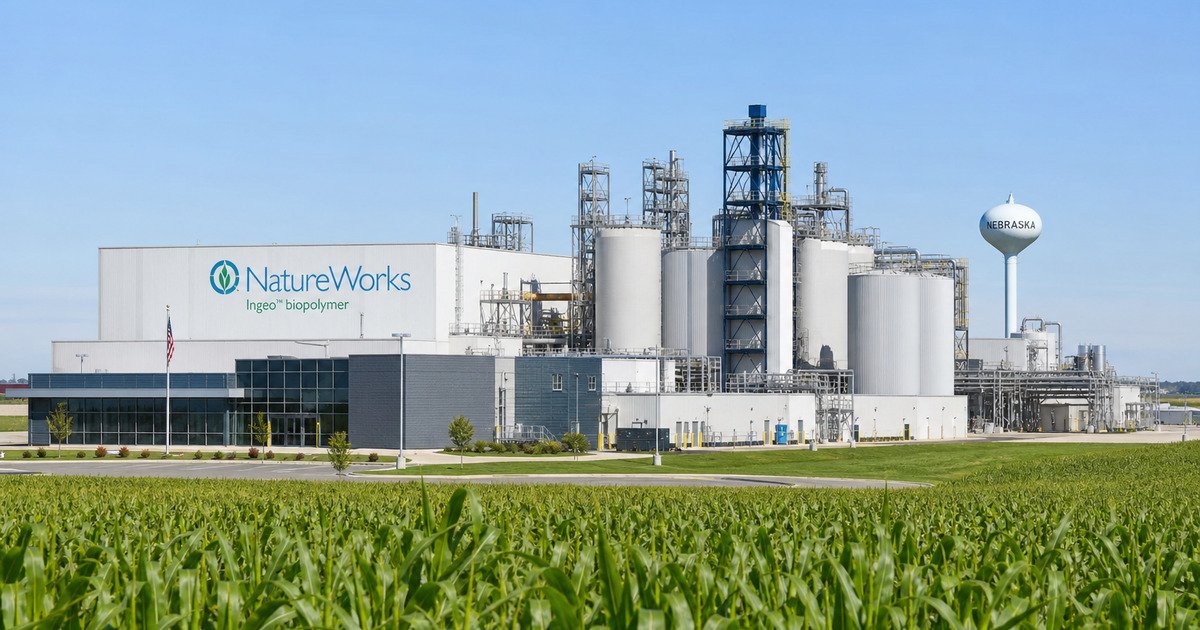
NatureWorks LLC, the world’s largest producer of polylactic acid (PLA) bioplastic, has announced a transformative $600 million investment that will triple its PLA production capacity by 2027. The expansion represents one of the single largest investments in bioplastics manufacturing capacity globally and signals growing confidence in the long-term demand outlook for bio-based plastics.
The Expansion Plan
NatureWorks will add two new world-class production lines at its flagship manufacturing facility in Blair, Nebraska, increasing annual production capacity from the current 150,000 tonnes to approximately 450,000 tonnes of Ingeo PLA bioplastic. The expansion represents a near-tripling of capacity at the site that has been NatureWorks’ primary production hub since the company’s founding.
The Blair facility will become the world’s largest PLA production site, consolidating NatureWorks’ position as the global leader in biobased and biodegradable plastics. The new production lines will incorporate the latest advances in lactide purification and PLA polymerization technology, resulting in improved product quality, lower energy consumption, and reduced production costs.
Market Drivers
The expansion comes in response to surging global demand for sustainable plastic alternatives across multiple end-use markets:
- Packaging — The single largest market for PLA, driven by brand owner sustainability commitments and regulatory restrictions on conventional plastics
- Food service — Compostable cutlery, cups, plates, and food containers replacing banned single-use plastic items
- 3D printing — PLA is the most widely used material in fused filament fabrication (FFF) 3D printing, and this market continues to grow rapidly
- Textiles — Bio-based PLA fibers for clothing, home textiles, and technical fabrics
- Agriculture — Biodegradable mulch films and plant pots replacing conventional plastic products
- Consumer electronics — Housings and components for sustainable electronics products
Industry forecasts project global PLA demand will exceed 1 million tonnes per year by 2030, up from approximately 400,000 tonnes in 2024. NatureWorks’ expansion positions the company to serve this growing demand while maintaining its market-leading position.
The $600 Million Investment
The $600 million capital investment reflects NatureWorks’ confidence in the long-term growth trajectory of the PLA market. The investment covers:
- New polymerization lines — State-of-the-art PLA production equipment with enhanced efficiency and product consistency
- Lactide purification upgrades — Improved feedstock processing to handle a wider range of raw material inputs
- Utilities and infrastructure — Expanded steam, cooling, and waste treatment systems to support increased production
- Logistics and warehousing — Enhanced product storage and distribution capabilities
- R&D facilities — New laboratory and pilot plant space for next-generation PLA development
The investment is expected to create approximately 200 new permanent jobs at the Blair facility, with an additional 500-800 construction jobs during the building phase.
Ingeo: NatureWorks’ PLA Platform
Ingeo is NatureWorks’ proprietary PLA bioplastic made from annually renewable plant sources — primarily corn starch in North America. The production process converts plant-derived sugars into lactic acid through fermentation, which is then purified and polymerized into PLA resin.
Ingeo offers several key advantages over conventional plastics:
- Bio-based — Made from 100% annually renewable plant resources
- Compostable — Breaks down in industrial composting facilities within 90 days
- Versatile — Suitable for injection molding, extrusion, thermoforming, blow molding, fiber spinning, and 3D printing
- Carbon efficient — Production generates significantly lower greenhouse gas emissions than petroleum-based plastics
- Food-safe — Approved for food contact applications by regulatory agencies worldwide
Sustainability Impact
The capacity expansion will significantly increase the availability of low-carbon bioplastic alternatives to conventional plastics. Based on NatureWorks’ lifecycle assessments:
- Carbon footprint — Ingeo PLA generates up to 80% fewer greenhouse gas emissions compared to petroleum-based plastics like PET and polystyrene
- Fossil resource displacement — Every tonne of PLA produced displaces approximately 1.5 tonnes of petroleum-based plastic
- End-of-life options — Ingeo products can be composted in industrial facilities, mechanically recycled, or chemically recycled back to lactide monomer
The expanded capacity will displace an estimated 450,000 tonnes of petroleum-based plastic annually, equivalent to removing approximately 200,000 cars from the road in terms of greenhouse gas emissions.
North American Bio-Economy
The Blair, Nebraska facility anchors a growing North American bio-economy centered on converting agricultural products into high-value biomaterials. The facility sources corn from farms across the Midwest, supporting rural economies and creating a market for sustainically grown crops that goes beyond food and feed.
The expansion reinforces NatureWorks’ commitment to domestic bioplastics production, reducing the need for North American manufacturers to import PLA from overseas suppliers and shortening supply chains for companies seeking bio-based materials.
Competitive Landscape
NatureWorks’ expansion comes as the global PLA market becomes increasingly competitive. Other major producers including TotalEnergies Corbion (Thailand/Netherlands), Hisun Biomaterials (China), and several Chinese PLA producers have also announced capacity expansions.
However, NatureWorks’ scale, technology leadership, and established customer relationships give it a strong competitive position. The company’s Ingeo product portfolio spans over 30 grades optimized for different applications, supported by deep technical expertise in PLA processing and application development.
Looking Ahead
The 2027 completion target for the expansion positions NatureWorks to serve the next wave of PLA demand growth driven by:
- EU Packaging Regulation — The PPWR’s recyclability and recycled content mandates will drive European demand for compostable alternatives
- Corporate sustainability targets — Major consumer goods companies have committed to 100% recyclable, reusable, or compostable packaging by 2025-2030
- PLA recycling infrastructure — Emerging chemical recycling technologies will enable PLA to be recycled back to its monomer, creating a circular economy for the material
- New applications — Ongoing R&D is expanding PLA into new applications including durable goods, automotive components, and construction materials
NatureWorks’ $600 million bet on PLA capacity expansion reflects a broader industry conviction that bioplastics are transitioning from niche alternatives to mainstream materials — and that the companies that invest in scale now will be best positioned to lead this transformation.