EU's PPWR Comes Into Effect as Packaging Industry Innovates and Navigates Compliance
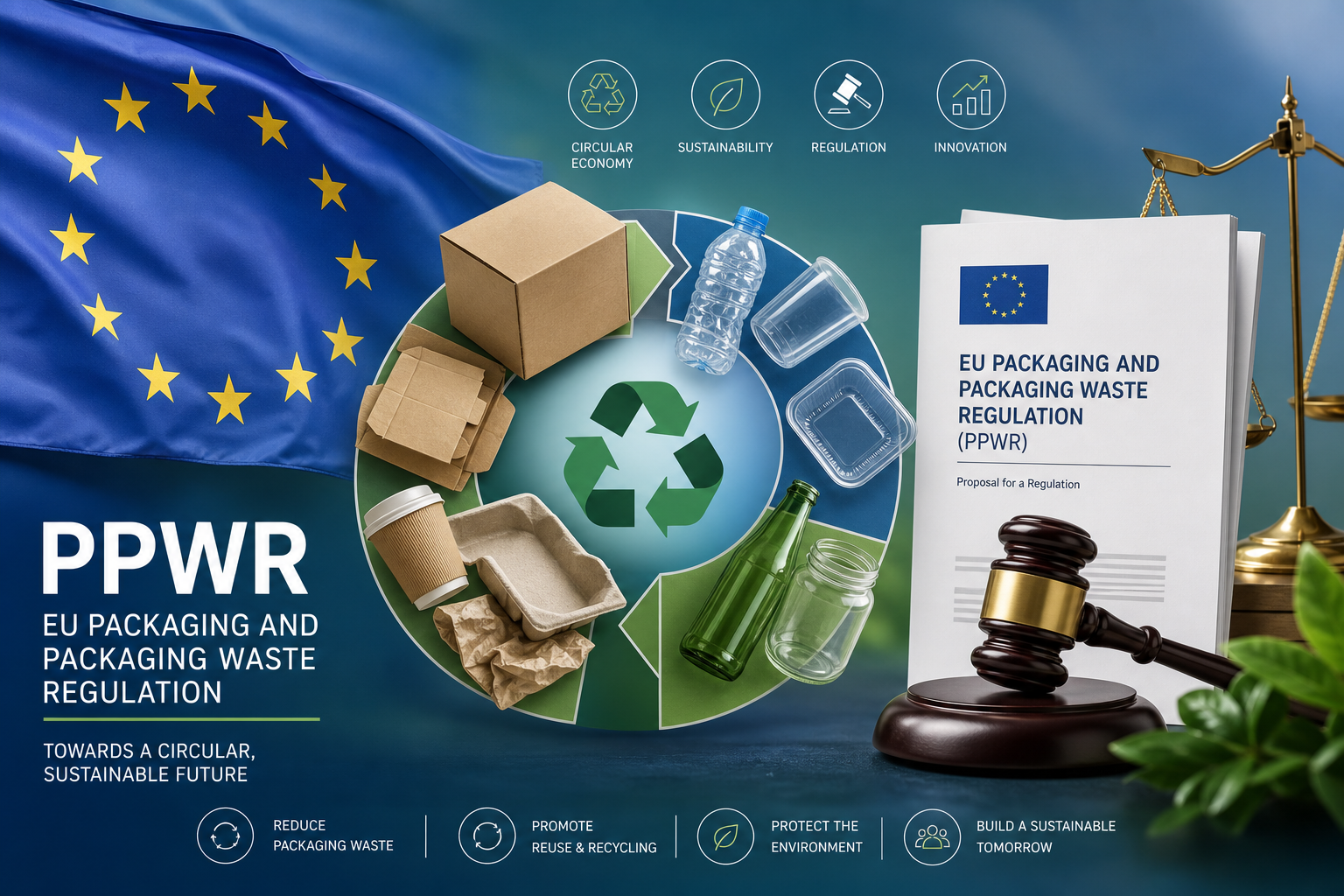
The EU Packaging and Packaging Waste Regulation (PPWR) has crossed a critical threshold. As of August 12, 2026, the regulation generally applies across the European Union, marking the most significant overhaul of packaging legislation in decades. For an industry that has spent years preparing, debating, and lobbying, the date is not a finish line but a starting gun — the moment when harmonized requirements for recyclability, reuse, recycled content, and substance restrictions become legally enforceable for all packaging placed on the EU market.
The regulation, published in the Official Journal on January 22, 2025, after years of negotiation, seeks to harmonize national measures while preventing packaging’s adverse environmental effects. It applies to packaging of any material and sets requirements spanning manufacturing, composition, reuse, and recovery. But the text alone only tells part of the story. Since publication, the industry has been in motion — developing recyclable barrier films, redesigning multi-material structures, adopting digital product passports, and pushing back on timelines and definitions that many argue remain ambiguous.
Packaging Insights, tracking the sector’s response since the regulation’s final form emerged, has documented a landscape in flux. The transition has been anything but smooth. Industry associations, NGOs, and individual companies have clashed over what “recyclable at scale” means in practice, whether reuse targets are technically feasible for certain formats, and how the new Environmental Omnibus — the Commission’s simplification package — will intersect with PPWR implementation. Felix Gass, founder and director of Packaging Strategy Lab, captured a prevailing sentiment when he noted that one of the biggest misconceptions is believing August 12 marks the beginning of the journey. In his view, packaging must be compliant and defensible on day one.
The recyclability criteria, perhaps the regulation’s most consequential pillar, require packaging to be designed for recycling and effectively collected, sorted, and recycled at scale. RecyClass and other certification bodies have seen a surge in assessments as brands scramble to validate their portfolios. The challenge is acute for flexible packaging, where multi-layer structures that once provided optimal barrier properties now face redesign pressure. Chemical recycling, while recognized as a pathway, remains constrained by capacity and methodological debates over mass balance attribution.
Reuse targets add another layer of complexity. The regulation sets mandatory reuse targets for specific packaging formats — beverage containers, transport packaging, and grouped packaging — with escalating percentages through 2030 and 2040. For carbonated soft drinks, wine, and other categories, the shift from single-use to refill systems implies logistics, hygiene, and infrastructure investments that many mid-sized producers find daunting. The European Organisation for Packaging and the Environment (EUROPEN) and Zero Waste Europe have offered divergent assessments of the Omnibus simplification’s impact, with the former welcoming clarity and the latter warning of dilution.
Substance restrictions, particularly on PFAS in food-contact packaging and heavy metals, have forced reformulation timelines that compress what would normally be multi-year R&D cycles. The Commission’s delegated acts on methodologies for calculating recycled content, recyclability performance grades, and reuse system effectiveness are still forthcoming in several areas, leaving companies to implement based on best available guidance rather than final rules.
Yet amid the uncertainty, innovation has accelerated. Barrier coatings that enable mono-material recyclability, digital watermarking for sortation, refill-at-home and return-on-the-go models, and bio-based alternatives to fossil-derived polymers have all moved from pilot to commercial deployment faster than the pre-PPWR trajectory suggested. The regulation, for all its implementation friction, has functioned as a catalyst — concentrating investment and focusing technical talent on problems the industry had previously deferred.
As the first compliance cycle begins, the packaging value chain enters a period of evidence-based enforcement. National authorities will assess market surveillance data, RecyClass and equivalent schemes will feed into the EU’s recyclability performance grades, and the first corporate disclosures under the Corporate Sustainability Reporting Directive will intersect with PPWR obligations. The coming months will reveal whether the regulation’s architecture — harmonized, ambitious, and enforceable — produces the circular outcomes it promises, or whether the gap between text and practice widens. For now, the industry’s message is clear: the work has only just begun.
Sources
- Packaging Insights, “EU’s PPWR comes into effect as packaging industry innovates and navigates compliance,” published August 12, 2026. Available at: https://www.packaginginsights.com/news/eu-ppwr-comes-into-effect.html
- European Commission, “Regulation (EU) 2025/XX on packaging and packaging waste (PPWR),” Official Journal, January 22, 2025.
- RecyClass, Recyclability evaluation protocols and certification schemes. Available at: https://recyclass.eu/
- European Organisation for Packaging and the Environment (EUROPEN), Position on Environmental Omnibus and PPWR implementation, 2026.
- Zero Waste Europe, Analysis of Environmental Omnibus impact on packaging legislation, 2026.