Ecopha Unveils Bhutan Carbon Platform: A Carbon-Negative Circular Bioeconomy Model
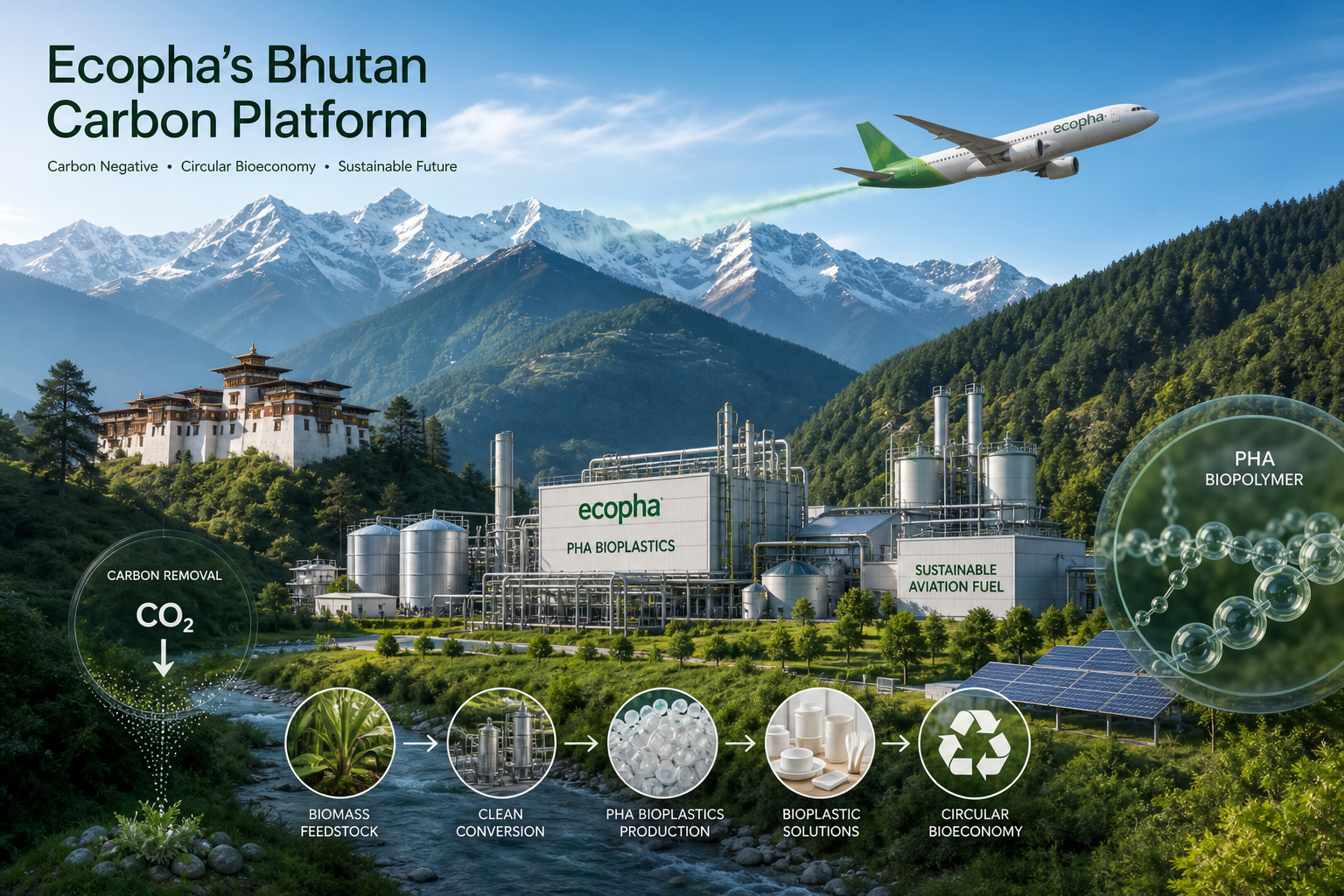
In the eastern Himalayas, where the kingdom of Bhutan has long measured progress through Gross National Happiness rather than gross domestic product, a new kind of industrial model is taking shape — one that could redefine how the world thinks about carbon, chemistry, and circularity.
Ecopha Biotech, a company already known for its polyhydroxyalkanoate (PHA) bioplastics technology, has unveiled the Bhutan Carbon Platform, a conceptual framework presented in a short-form video that stitches together carbon removal, sustainable aviation fuel (SAF), and bioplastic production into a single, carbon-negative loop. The platform, introduced in a video published on the company’s website, positions Bhutan not merely as a backdrop but as an active participant in a system designed to pull more carbon from the atmosphere than it emits.
The concept is deceptively simple in its ambition. Carbon dioxide is captured — whether from ambient air or industrial point sources — and converted through biological and catalytic pathways into intermediate molecules that feed two parallel tracks. One track produces sustainable aviation fuel, addressing one of transportation’s most stubborn decarbonisation challenges. The other feeds Ecopha’s PHA fermentation process, yielding biodegradable bioplastics that can replace conventional petrochemical polymers in packaging, agriculture, and medical applications.
What makes the Bhutan Carbon Platform distinctive is its insistence on circularity at every stage. The bioplastics produced are designed to return to the system at end of life — composted, anaerobically digested, or chemically recycled — releasing carbon that can be captured again. The energy inputs for the entire chain are envisioned as renewable, leveraging Bhutan’s abundant hydropower. The result, Ecopha argues, is a system that is not merely low-carbon but actively carbon-negative: each tonne of PHA or SAF produced represents a net withdrawal of CO₂ from the atmosphere.
Bhutan’s role in this vision is more than symbolic. The country’s constitution mandates that at least 60% of its land remain under forest cover, and it is one of the few nations already carbon-negative at the national level. Its grid runs almost entirely on hydropower. For a platform that sells itself on carbon negativity and renewable energy, Bhutan offers a rare alignment of policy, geography, and infrastructure.
Ecopha’s video, titled “Bhutan Carbon Short,” runs just over a minute but packs in the full arc of the platform: drone footage of forested valleys and snow-capped peaks gives way to animated process diagrams showing CO₂ capture, SAF synthesis, and PHA fermentation. The narration, delivered in English with subtitles, frames the platform as a replicable model — one that could, in principle, be adapted to other geographies with similar renewable energy endowments and carbon sequestration potential.
The company has not disclosed commercial timelines, offtake agreements, or capital commitments for a full-scale facility in Bhutan. The video appears intended as a proof-of-concept and a conversation starter with governments, investors, and strategic partners in the aviation and materials sectors. But the specificity of the technical claims — named pathways, identified co-products, a defined geography — suggests the concept has advanced well beyond the slide-deck stage.
For the bioplastics industry, the Bhutan Carbon Platform represents an evolution in how PHA companies position themselves. The first wave of PHA commercialization focused on dropping in to existing plastics supply chains: same properties, same applications, bio-based origin. The second wave, exemplified by Ecopha’s platform, treats PHA as one node in a larger carbon management system — where the plastic’s biodegradability is not just an environmental benefit but a functional requirement for closing the carbon loop.
Whether the platform moves from video to pilot plant will depend on the usual constellation of factors: policy incentives for SAF and carbon removal, offtake certainty for both fuel and polymer, and the willingness of project finance to back a novel integrated facility in a landlocked Himalayan kingdom. But as a conceptual contribution, the Bhutan Carbon Platform does something valuable: it refuses the false choice between decarbonising aviation and decarbonising materials, and instead proposes a topology where both serve the same carbon-negative logic.
In a sector often accused of greenwashing — where “bio-based” is conflated with “biodegradable,” and “circular” is invoked more often than engineered — Ecopha’s model stands out for its systems-level honesty. It admits that carbon negativity requires renewable energy, that circularity requires end-of-life infrastructure, and that both require a geography willing to host the experiment. Bhutan, it turns out, may be exactly that geography.
Sources
- Ecopha Biotech, “Bhutan Carbon Short | Ecopha,” published August 5, 2026. Available at: https://ecopha.bio/bhutan-carbon-short/
- Ecopha Biotech website, company and technology overview. Available at: https://ecopha.bio/
- Kingdom of Bhutan, Constitutional mandate on forest cover (Article 5, Section 3). Available at: https://www.nab.gov.bt/
- International Energy Agency, “Sustainable Aviation Fuels” tracking report, 2024.
- European Bioplastics, “Market data: Global production capacities of bioplastics 2024-2029.”