DuPont's MemCor MBR Selected for Australia's Largest Inland Wastewater Treatment Expansion
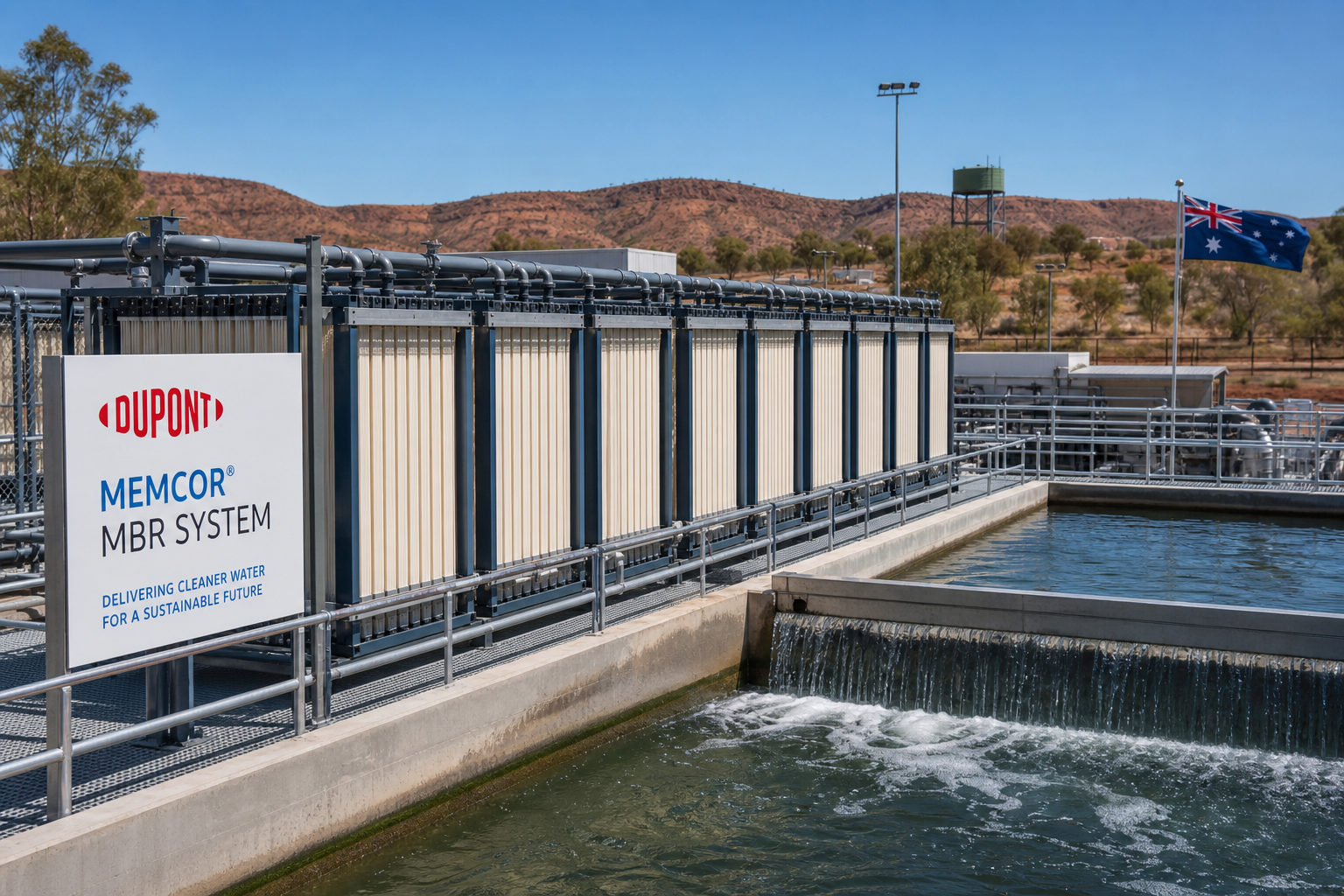
In the arid interior of Australia, where water scarcity is not a hypothetical risk but a daily reality, the country’s largest inland wastewater treatment facility is preparing for a significant expansion — and it has chosen DuPont’s MemCor membrane bioreactor (MBR) technology to do the heavy lifting.
The facility, located in a region where every megalitre of recycled water counts toward agricultural, industrial, and municipal supply resilience, will deploy DuPont’s MemCor submerged MBR modules to increase treatment capacity and elevate effluent quality to standards suitable for direct reuse. The selection, announced by DuPont on August 11, 2026, underscores a broader shift in Australian water infrastructure: from disposal-oriented treatment to fit-for-purpose water recycling at scale.
Membrane bioreactors have long been recognised for their ability to produce consistently high-quality effluent within a compact footprint — a critical advantage when expanding within the constrained boundaries of an existing plant. What distinguishes DuPont’s MemCor system is its hollow-fibre membrane configuration, which combines high permeability with robust mechanical strength, allowing operators to run at higher fluxes without sacrificing membrane life. The modules are designed for outside-in filtration, which simplifies cleaning regimes and reduces the frequency of chemical-intensive maintenance cycles.
For the Australian facility, these operational characteristics translate directly into reliability. Inland communities cannot afford extended downtime or effluent quality excursions; the recycled water stream feeds irrigation schemes, industrial cooling, and, increasingly, managed aquifer recharge projects that buffer groundwater supplies against multi-year droughts. The MemCor system’s proven track record in similar climates — including installations across the Middle East, the southwestern United States, and regional Australia — likely weighed heavily in the selection process.
The expansion itself is part of a multi-year water security strategy that recognises wastewater not as a waste stream but as a perennial, climate-independent water source. As rainfall patterns grow more erratic and surface water allocations tighten, inland utilities are investing in treatment trains that can deliver Class A+ recycled water — suitable for unrestricted irrigation, industrial processes, and indirect potable reuse — without the land-intensive lagoon systems of the past.
DuPont’s press release notes that the MemCor installation will integrate with the facility’s existing biological treatment infrastructure, upgrading it from conventional activated sludge to a full MBR process. This retrofit approach minimises civil works, accelerates commissioning, and preserves the utility’s investment in its current asset base. The expanded plant is expected to come online in phases, with the first MBR train operational within the next 18 months.
Beyond the immediate capacity increase, the project signals a maturing of the Australian water recycling market. Where early MBR adopters were often coastal utilities with ocean outfall alternatives, inland facilities are now embracing the technology as a strategic necessity rather than a pilot-scale experiment. The economics have shifted: the levelised cost of MBR-produced recycled water, when measured against the avoided cost of new surface water infrastructure or emergency water carting, increasingly stacks up — especially when carbon pricing and community expectation are factored in.
For DuPont, the win reinforces its position in the municipal MBR segment, where it competes with the likes of Suez (ZeeWeed), Kubota, and Toray. The company has been investing in next-generation membrane chemistries that reduce fouling propensity and extend module warranty periods — both key levers for lowering total cost of ownership over a 20-year asset life.
The Australian project also highlights an underappreciated synergy: the same membrane technology that enables water recycling at inland wastewater plants is finding adjacent applications in industrial water reuse, food and beverage processing, and even the emerging green hydrogen sector, where ultra-pure water feedstock is a non-negotiable requirement for electrolyser longevity.
As the expansion progresses, the facility will serve as a reference case for other inland utilities across Australia and comparable arid regions globally. The message is clear: membrane bioreactors are no longer a niche solution for space-constrained sites; they are becoming the default choice for any utility that treats water reuse as a core pillar of long-term supply resilience.
In a continent where the next drought is always a question of when, not if, that resilience is not optional — it is existential.
Sources
- DuPont, “Australia’s Largest Inland Wastewater Treatment Facility Selects MemCor™ MBR System for Expansion,” press release, August 11, 2026. Available at: https://www.dupont.com/news/australia-largest-inland-wastewater-treatment-facility-selects-memcor-mbr-system-for-expansion.html
- DuPont Water Solutions, MemCor MBR product documentation. Available at: https://www.dupont.com/water/
- Australian Water Association, “National Water Recycling Guidelines,” 2023 update.
- Water Services Association of Australia (WSAA), “Urban Water Security Outlook,” 2025.
- International Water Association (IWA), “Membrane Bioreactor Technology: Status and Trends,” 2024.