DoD Awards $42 Million Across 25 Projects to Build Distributed U.S. Bioindustrial Manufacturing Base
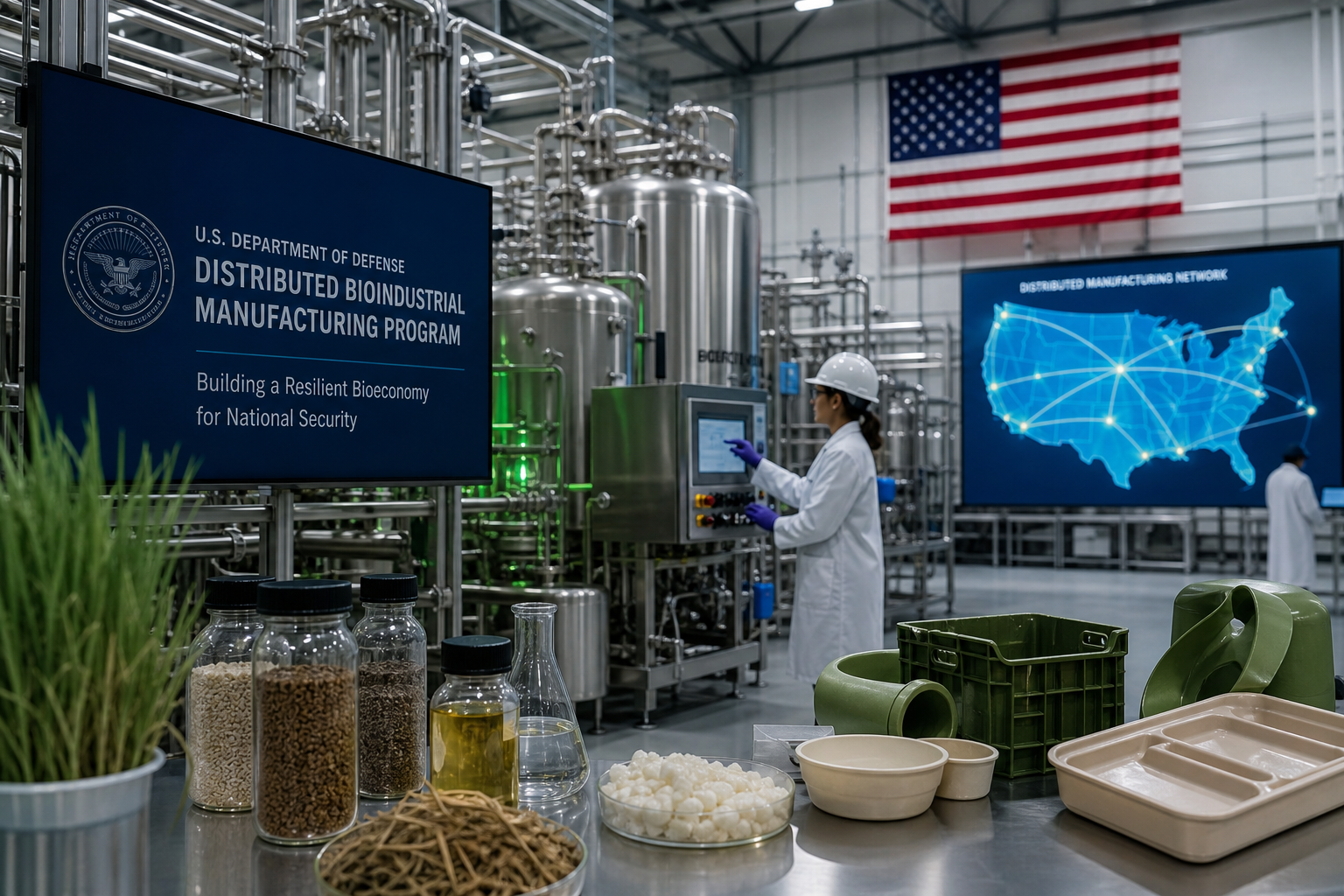
When the U.S. Department of Defense talks about supply chain resilience, it does not reach for metaphors. It writes contracts, sets milestones, and measures progress in tonnes of domestic production capacity. On September 13, 2024, the DoD announced 12 additional awards under its Distributed Bioindustrial Manufacturing Program (DBIMP), bringing the programme’s cumulative investment to $42 million across 25 projects — a deliberate, phased effort to build a distributed, domestic bioindustrial base capable of producing critical materials at scale, on demand, and without reliance on fragile global logistics.
The DBIMP, managed by the Office of the Assistant Secretary of Defense for Industrial Base Policy, was conceived in response to a stark vulnerability: the United States, despite its historical leadership in biotechnology, lacks sufficient domestic fermentation and downstream processing capacity to translate laboratory discoveries into manufactured goods when global supply chains fracture. The COVID-19 pandemic, the 2021–2022 semiconductor shortage, and ongoing geopolitical tensions have all reinforced the same lesson — that strategic materials, whether they are small-molecule active pharmaceutical ingredients, specialty polymers, or bio-based drop-in replacements for petrochemicals, must be producible within U.S. borders.
The 12 new awards, added to the 13 initial projects selected in earlier tranches, span a deliberately diverse portfolio: microbial strain development for novel monomers, pilot-scale fermentation optimisation, modular bioreactor design, downstream separation technologies, and techno-economic analyses that de-risk the path to commercial-scale facilities. What unifies them is the programme’s core thesis — that distributed manufacturing, rather than a handful of mega-facilities, offers the resilience the defence industrial base requires. A network of smaller, regionally distributed biomanufacturing nodes can survive disruptions that would cripple a centralised plant; it can flex to produce different molecules as demand shifts; and it can leverage local feedstocks, from agricultural residues to municipal waste streams, reducing both logistics costs and carbon intensity.
Erg Bio, a biomanufacturing company focused on converting waste biomass into high-value chemicals, was among the entities tracking the announcement closely. The company’s technology platform — which integrates pretreatment, enzymatic hydrolysis, and precision fermentation to produce platform chemicals from lignocellulosic feedstocks — aligns directly with the DBIMP’s emphasis on feedstock flexibility and distributed production. While the DoD does not publicly disclose individual award amounts or recipient names in aggregate announcements, the programme’s structure makes clear that successful Phase 1 performers become eligible for follow-on funding that can scale to $100 million per project for the construction of U.S.-based bioindustrial manufacturing facilities.
This phased funding model — concept, pilot, demonstration, commercial — mirrors the DoD’s long-standing approach to de-risking hard-tech innovation. It also addresses a persistent gap in the bioeconomy: the “valley of death” between academic proof-of-concept and bankable commercial projects. By underwriting the intermediate steps, the DBIMP creates a pipeline of projects that private project finance can eventually underwrite on commercial terms.
The strategic rationale extends beyond pandemic preparedness. The defence industrial base relies on a surprisingly wide range of bio-derived or bio-enabled materials: high-performance lubricants for jet engines, specialty coatings for corrosion protection, energetic materials precursors, lightweight composites for airframes, and even the carbon fibres that reinforce them. Many of these currently depend on single-source foreign suppliers or on petrochemical feedstocks whose price and availability are subject to geopolitical forces outside U.S. control. A domestic bioindustrial base that can produce drop-in replacements — or superior bio-advantaged alternatives — transforms a strategic liability into a sovereign capability.
The distributed model also has implications for rural economic development. Bioindustrial facilities, unlike semiconductor fabs or heavy steel mills, can be sited near their feedstock — which often means near agricultural and forestry communities that have struggled with depopulation and declining commodity markets. The DBIMP’s geographic distribution criteria explicitly encourage this alignment, creating a feedback loop where national security investment revitalises the very communities that supply the biomass.
Critics of federal bioeconomy programmes often point to the long timelines and high capital intensity of biomanufacturing — fermentation facilities take years to permit, build, and validate, and their economics are sensitive to feedstock cost volatility. The DBIMP attempts to mitigate these risks through its modular, distributed architecture and its insistence on techno-economic rigour at every phase. But the ultimate test will be whether the projects that graduate from the programme can compete unsubsidised in commercial markets — or whether the defence premium they command becomes a permanent crutch.
For now, the numbers tell a story of accelerating commitment: 25 projects, $42 million committed, and a pathway to $100 million per project for facility construction. In the vocabulary of the defence industrial base, that is not a pilot programme — it is the beginning of a new supply chain.
As the DBIMP moves from awards to groundbreaking, the bioplastics and bio-based chemicals sectors should pay close attention. The technologies de-risked here — robust strains, flexible feedstocks, modular reactors, efficient separations — are precisely the building blocks the broader bioeconomy needs to move from niche to mainstream. The DoD is not in the business of making bioplastics; it is in the business of ensuring that when the nation needs a molecule, it can be made here. If that mission builds a domestic bioindustrial base along the way, the civilian economy will be the beneficiary.
Sources
- U.S. Department of Defense, “DoD Releases 12 Awards for Distributed Bioindustrial Manufacturing Program,” press release, September 13, 2024. Available at: https://www.war.gov/News/Releases/Release/Article/3904890/dod-releases-12-awards-for-distributed-bioindustrial-manufacturing-program/
- Erg Bio, “DoD Releases 12 Awards for Distributed Bioindustrial Manufacturing Program,” company coverage, November 18, 2025. Available at: https://ergbio.com/dod-releases-12-awards-for-distributed-bioindustrial-manufacturing-program/
- Office of the Assistant Secretary of Defense for Industrial Base Policy, Distributed Bioindustrial Manufacturing Program (DBIMP) overview.
- Congressional Research Service, “The U.S. Bioeconomy: Federal Research and Development Investment,” 2024.
- National Academies of Sciences, Engineering, and Medicine, “Safeguarding the Bioeconomy,” 2020.