APR Recognizes Recyclable CSD Barrier Packaging with Up to 5% MXD6, Expanding Lightweight PET Solutions
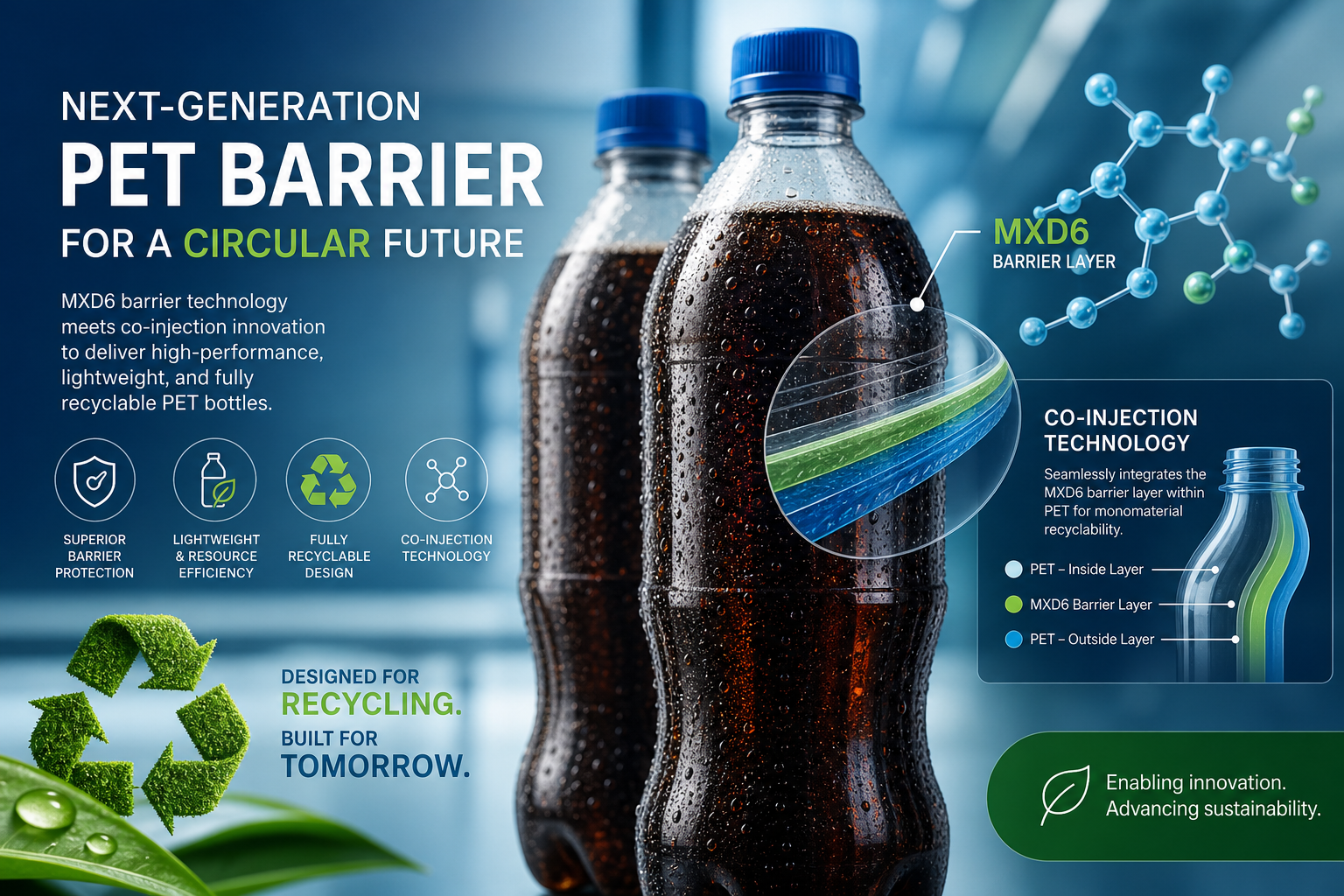
The Association of Plastic Recyclers (APR) has extended its recognition for recyclable PET barrier packaging to include up to 5% MXD6 content, marking the latest milestone in a progression that began with 2.5% in 2020 and advanced to 3.3% before reaching the current threshold. The recognition, achieved by long-time Husky partners Mitsubishi Gas Chemical (MGC) and REPI, expands the design space for carbonated soft drink (CSD) bottles that can now combine lightweighting, CO₂ retention, and full compatibility with the clear PET recycling stream.
For the beverage industry, the challenge has long been the physics of small-format bottles. As PET bottle sizes decrease below 355 milliliters, the surface-area-to-volume ratio increases sharply, accelerating carbon dioxide loss and reducing shelf life below commercial requirements. The traditional response — adding more PET resin to increase bottle weight — works against sustainability goals, raising material consumption, transport costs, and carbon footprint. Aluminum cans and glass offer excellent barrier performance but introduce their own trade-offs in cost, logistics, and environmental impact.
MXD6, a polyamide barrier polymer, has offered a technical solution for decades. By incorporating it into the bottle structure, brands can significantly improve CO₂ retention without heavy-weighting the PET. But the recycling question has been persistent: conventional blending methods and imprecise multi-layer structures risk contaminating the PET recycling stream, leading many brands to treat MXD6 as a contaminant and avoid it altogether in recyclability commitments.
The APR recognition changes that calculus. APR’s endorsement is globally referenced by brand owners, converters, and recyclers when evaluating packaging compatibility with PET recycling streams. The stepwise progression — 2.5% in 2020, 3.3% subsequently, and now up to 5% — reflects both technical validation and growing confidence in the co-injection technology that makes it possible.
Husky’s high-precision co-injection technology is the enabler. Unlike blend or sandwich approaches, co-injection places the barrier material precisely where it is most effective — typically in the bottle’s sidewall — while keeping the inner and outer surfaces pure PET. This precision allows engineers to optimize multiple performance levers simultaneously: PET weight, barrier-material usage, shelf life, and recyclability. The result is engineered packaging that uses only the amount of MXD6 required to hit the performance target, minimizing both cost and recycling-stream impact.
Each recognition threshold has unlocked new bottle formats. The original 2.5% MXD6 solution suited bottles above 16 grams. The 3.3% recognition extended applicability to bottles around 12 grams. Now, at up to 5%, the design space expands further, giving brands greater flexibility to balance shelf life, lightweighting, recyclability, and cost across a broader range of formats — including demanding climates and distribution conditions where monolayer PET falls short.
The benefits cascade across the value chain: enhanced CO₂ retention for lightweight small-format bottles; reduced PET usage through bottle lightweighting; optimized MXD6 consumption through precise placement; compatibility with established PET recycling streams; greater flexibility for demanding climates; expanded design flexibility across bottle formats; and lower total material consumption while maintaining shelf-life requirements.
For MGC and REPI, the recognition validates a long-term partnership with Husky in advancing barrier technology. For brands, it removes a recurring barrier to adopting recyclable high-barrier PET — the fear of recycling-stream rejection. And for the recycling industry, it adds a vetted, recognized material combination to the stream of packaging that can confidently be processed as clear PET.
As the EU’s Packaging and Packaging Waste Regulation takes effect and global brands face mounting pressure to deliver on recyclability commitments, the APR’s 5% MXD6 recognition arrives at a pivotal moment. It demonstrates that the traditional trade-off between product protection and circularity is not immutable — that engineering precision can reconcile barrier performance with recycling-stream compatibility. The question for beverage producers is no longer whether recyclable barrier PET is possible, but how quickly they can integrate it into their packaging portfolios.
Sources
- Husky Injection Molding Systems, “APR Recognizes Recyclable CSD Barrier Packaging with Up to 5% MXD6,” blog post, August 14, 2026. Available at: https://www.husky.co/en/resources/blog/recyclable-csd-barrier-packaging-apr-recognition/
- Association of Plastic Recyclers (APR), Recognition letters for MXD6 barrier packaging (2020, 2023, 2026).
- Mitsubishi Gas Chemical (MGC), MXD6 product documentation and applications.
- REPI, Barrier technology and co-injection solutions for PET packaging.
- Packaging Strategy Lab (PSL), Industry analysis on barrier packaging and recyclability trends, 2026.