BioBTX Develops Sustainable Graphite and Jet Fuel from Crude Glycerol
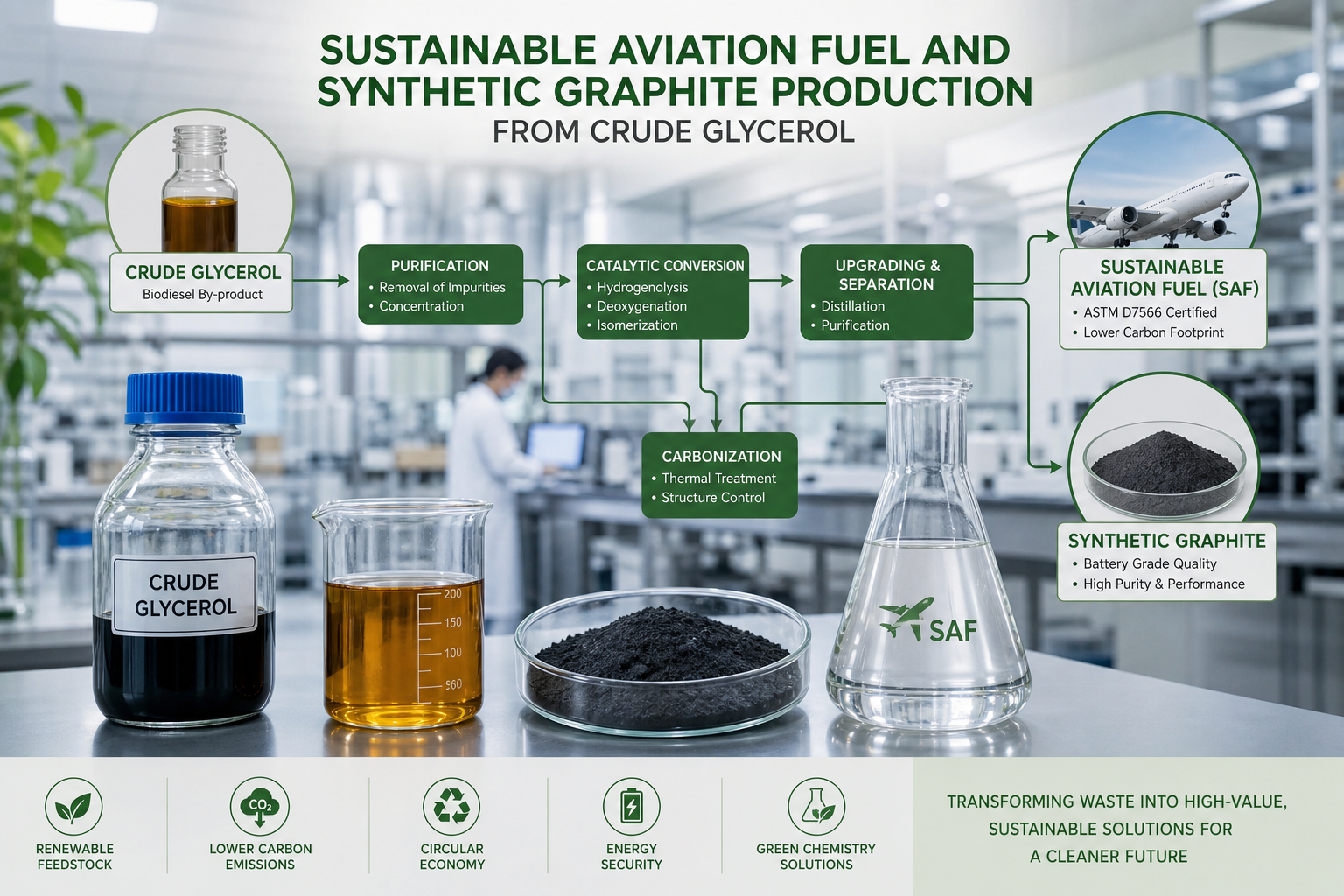
Groningen, July 2026 — The search for sustainable alternatives to fossil-based graphite and jet fuel has taken a significant step forward. BioBTX, the Dutch developer of renewable aromatics technology, announced it has collaborated with NC State University, the U.S. National Renewable Energy Laboratory (NREL), and BIRLA Carbon to develop a novel production route that converts crude glycerol into both sustainable aviation fuel (SAF) and synthetic graphite through its Integrated Catalytic Cyclic Process (ICCP) technology.
The research, which explores the valorization of polycyclic aromatic hydrocarbons (PAHs) produced from crude glycerol via BioBTX’s ICCP process, represents a novel approach to two critical sustainability challenges: decarbonizing aviation and securing a sustainable supply of graphite for lithium-ion batteries.
Crude glycerol, a by-product of biodiesel and oleochemical production, has long been an underutilized waste stream. BioBTX’s ICCP technology converts this glycerol into renewable aromatics — benzene, toluene, and xylenes (BTX) — which serve as building blocks for a wide range of chemicals and materials. The new research demonstrates that the PAH fraction from this process can be further refined into two high-value products: drop-in sustainable aviation fuel and synthetic graphite suitable for battery anodes.
The bio-graphite produced through this route has been tested in lithium-ion battery configurations and shows excellent performance, opening a potential new domestic supply chain for a critical battery material currently dominated by imports. For aviation, the SAF produced meets drop-in specifications, offering a pathway to reduce the sector’s carbon footprint without requiring fleet or infrastructure changes.
“This novel production route explores the valorization of poly aromatic hydrocarbons (PAH), produced out of crude glycerol via the BioBTX ICCP technology, into SAF and synthetic graphite,” BioBTX stated in its announcement. “The resulting bio-graphite exhibits excellent performance in lithium-ion battery configurations.”
The collaboration brings together complementary expertise: BioBTX’s ICCP technology for aromatics production, NC State University’s expertise in carbon materials, NREL’s capabilities in fuel analysis and process optimization, and BIRLA Carbon’s deep knowledge of carbon black and graphite markets.
The press release includes a downloadable PDF with further technical details on the ICCP process and the graphite characterization results.
As the EU and U.S. push for domestic critical mineral supply chains and the aviation sector faces mandates for SAF blending, this glycerol-to-graphite-and-SAF pathway represents a circular solution that transforms a waste stream into two strategic materials.
Sources:
- BioBTX, “Sustainable Graphite and Jet from crude glycerol,” press release, July 28, 2026. https://biobtx.com/sustainable-graphite-and-jet-from-crude-glycerol/
- BioBTX, “BioBTX Press release Graphite” (PDF). https://biobtx.com/wp-content/uploads/2025/03/BioBTX_Press_release_Graphite.pdf