The Story Behind Peracetic Acid: From Production to Bio-Based Innovation
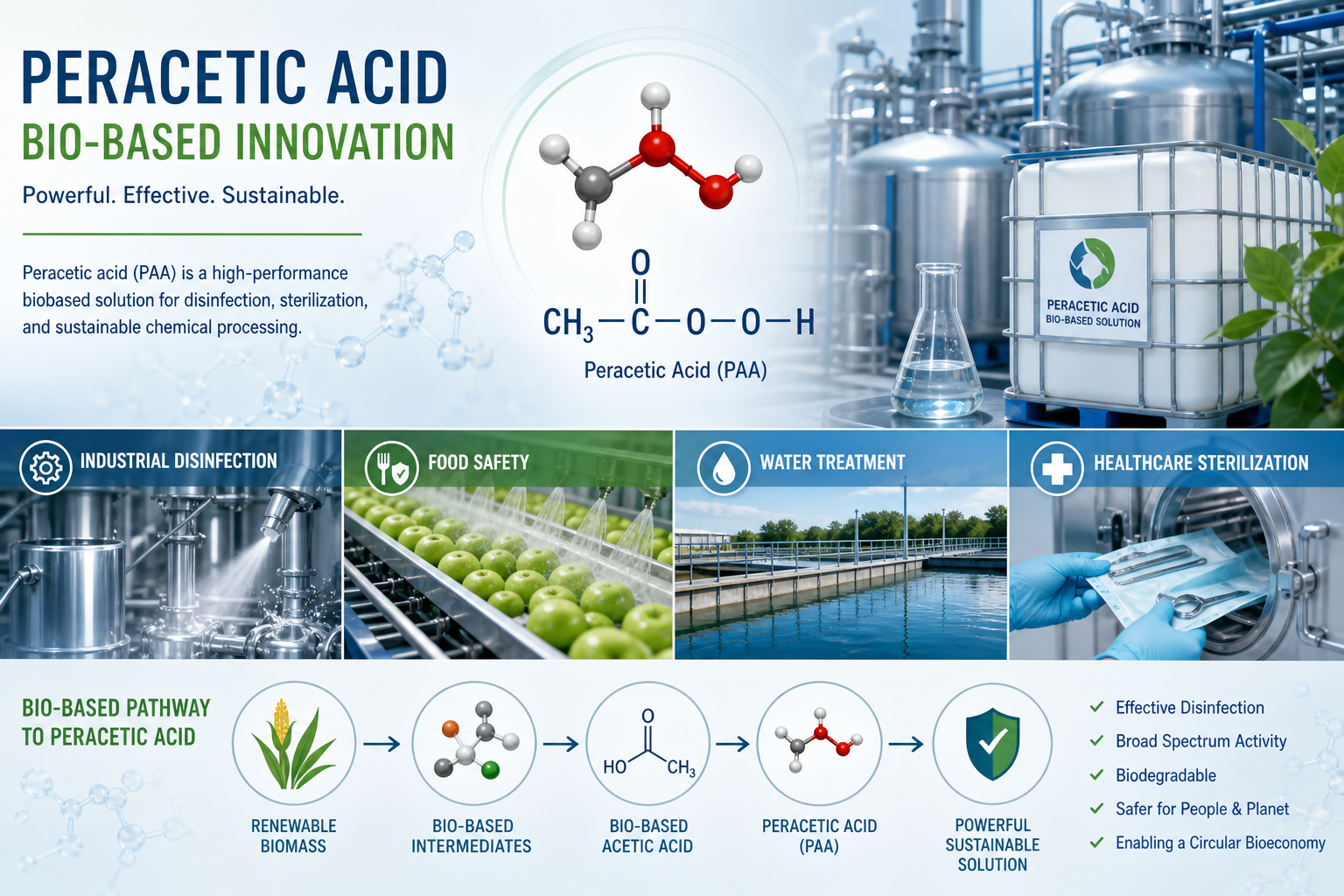
Peracetic acid, known in the industry as PAA, is one of the most effective and versatile cleaning agents used in modern industry. From food safety and water treatment to healthcare sterilization and renewable fuels production, demand for peracetic acid continues to grow as companies seek high-performance antimicrobial solutions with fewer environmental drawbacks than chlorine-based products. The North American market is expected to reach over $300 million by 2031 according to KBV Research.
But where does peracetic acid come from, why are there growing concerns about supply, and what role could bio-based peracetic acid play in the future?
Peracetic acid is a strong disinfectant formed by reacting acetic acid with hydrogen peroxide. Commercial solutions typically contain a mixture of peracetic acid, acetic acid, hydrogen peroxide, and water. The conventional manufacturing process involves the reaction between acetic acid and hydrogen peroxide in the presence of an acid catalyst: acetic acid plus hydrogen peroxide yields peracetic acid plus water.
Production is concentrated in regions with strong chemical manufacturing infrastructure — the United States, Europe, China, and other major industrial hubs — and is closely tied to the availability of acetic acid and hydrogen peroxide, making upstream feedstock markets critically important.
Major applications span food and beverage processing (sanitizing equipment, production lines, packaging systems, and produce washing), water and wastewater treatment (municipal disinfection, industrial wastewater, cooling water systems, and biofilm control), healthcare and sterilization (particularly for heat-sensitive equipment), pulp and paper (bleaching and microbial control, reducing reliance on chlorine-based products), and renewable fuels and specialty chemical manufacturing.
As demand grows, many buyers face challenges in procuring peracetic acid. Logistics constraints include transport regulations for oxidizing substances and temperature sensitivity, both of which complicate movement across states and national boundaries. Three main factors affect availability: feedstock volatility (disruptions in acetic acid or hydrogen peroxide markets affect pricing and availability), concentrated supply chains (production capacity is concentrated among a relatively small number of large chemical producers, creating bottlenecks during high demand), and specialized logistics requirements (peracetic acid is a reactive oxidizer requiring specialized handling, storage, and transportation).
One of the most important emerging trends is bio-based peracetic acid. Evonik’s 2026 announcement of a low-carbon peracetic acid product shows that users are now seeking lower-carbon and more traceable chemical supply chains, creating positive pressure toward non-fossil-derived feedstock alternatives. Traditional peracetic acid in the U.S. relies on petroleum-derived acetic acid, often sourced from logistically vulnerable producers in Texas’ Gulf Coast area.
Bio-based peracetic acid instead uses bio-based acetic acid, which can be produced from renewable feedstocks such as biomass, fermentation processes, agricultural residues, and renewable ethanol pathways such as Kemvera’s process. This can help end-use industry companies reduce Scope 3 emissions, improve supply chain resilience, meet sustainability targets, increase use of renewable carbon, and differentiate products in environmentally conscious markets.
At Kemvera, the future of bio-based peracetic acid in North America is seen as intrinsically linked to acetic acid’s supply chain stability. The mission is to build a domestic hub of bio-acetic acid supply to meet the needs of the chemical manufacturing industry — cleaner, more resilient chemical supply chains. Renewable sources of acetic acid can play a critical role in reducing dependence on fossil-derived feedstocks while supporting growing demand for high-performance chemistries such as peracetic acid.
By developing bio-based acetic acid pathways, the industry has an opportunity to create a more sustainable foundation for essential products used in food safety, water treatment, healthcare, and industrial processing.
Sources:
- Kemvera. “The Story Behind Peracetic Acid: From Production to Bio-Based Innovation.” July 22, 2026. https://www.kemvera.com/post/the-story-behind-peracetic-acid-from-production-to-bio-based-innovation
- KBV Research. “North America Peracetic Acid Market.” https://www.kbvresearch.com/north-america-peracetic-acid-market/
- Fortune Business Insights. “Peracetic Acid Market.” https://www.fortunebusinessinsights.com/peracetic-acid-market-104568
- Evonik. “Evonik launches peracetic acid with low carbon footprint.” June 2026. https://www.evonik.com/en/news/press-releases/2026/06/evonik-launches-peracetic-acid-with-low-carbon-footprint-for-the.html