Belgium First in Europe to Test Invisible Watermark Sorting for Flexible Food Packaging Recycling
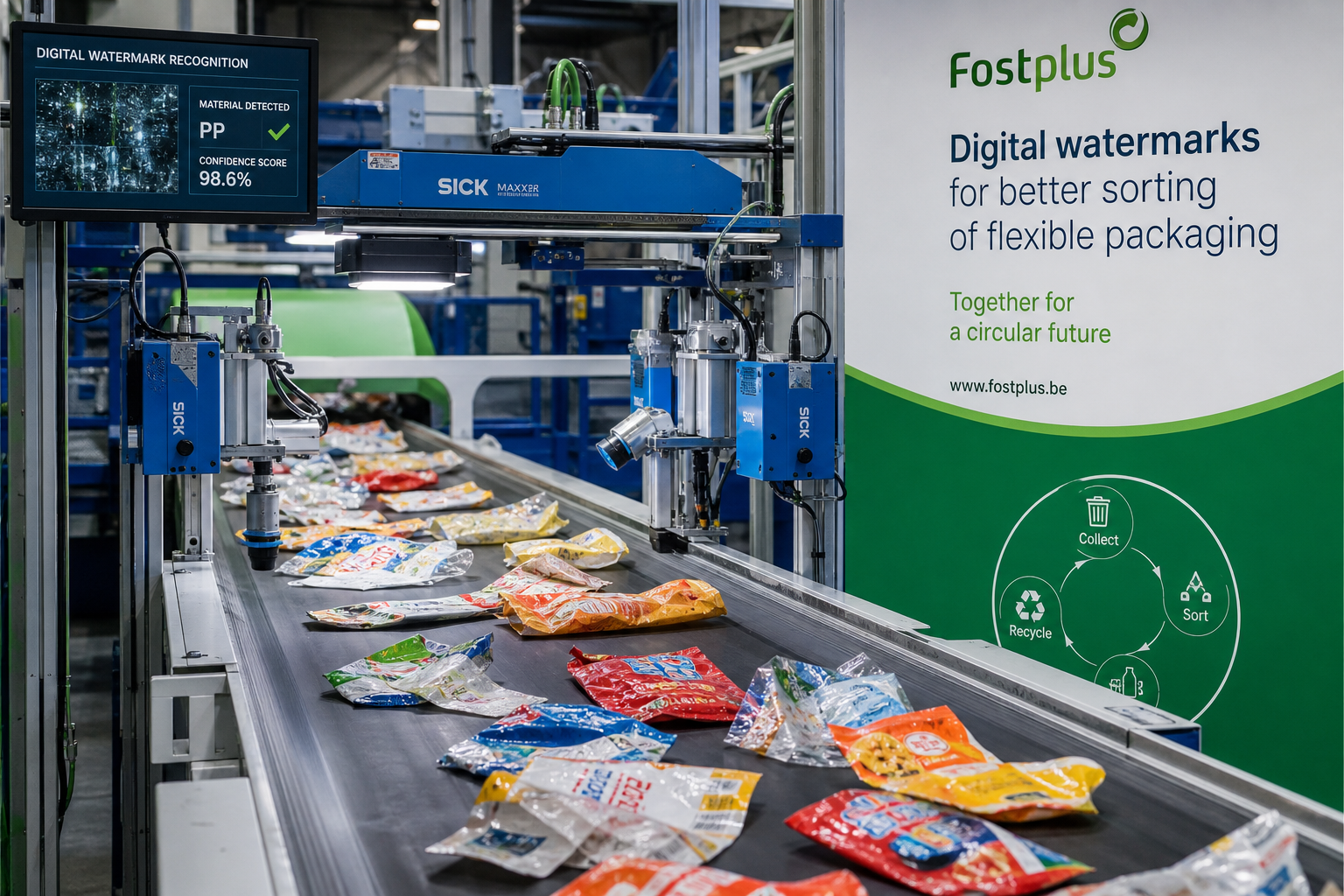
BRUSSELS, Belgium — Belgium has become the first country in Europe to launch a large-scale trial to recycle flexible food packaging — crisp bags, biscuit wrappers, and plastic films — collected through the PMD bag (Belgium’s bag for plastic, metal, and drink cartons) into new food packaging. The project, led by Fost Plus, the organisation coordinating household packaging recycling in Belgium, brings together major food companies Mondelēz International, Ferrero, PepsiCo, and pladis with sorting technology from Digimarc and Pellenc ST.
Digital Watermarks Enable Food/Non-Food Separation
For the project, packaging of consumer-favourite snacks now carries an invisible digital watermark — imperceptible to the naked eye but readable by high-resolution cameras on sorting lines. When a package arrives at a sorting centre via the PMD bag, cameras read the code and automatically route it to the correct waste stream.
“It’s similar to a QR code, invisible to the naked eye, that carries information about what the packaging once held,” said Philippe Gendebien, Business Innovation Manager at Fost Plus. “While we already sort packaging into 16 material streams today, this technology lets us add an extra step — also distinguishing between food and non-food packaging.”
This distinction matters because strict rules govern recycled plastic in food contact applications. To date, only recycled PET from bottles and trays qualifies for food packaging via mechanical recycling, since over 95% of PET in the PMD stream originates from food packaging. For flexible packaging like pouches and films, conventional sorting cannot separate food-contact from non-food-contact streams — a barrier the watermark technology aims to overcome.
HolyGrail 2.0 Consortium Drives Innovation
The technology is being tested as part of the European HolyGrail 2030 – Circular Packaging Consortium programme, a consortium of around 75 local, European, and global companies and organisations facilitated by AIM (European Brands Association). The initiative explores advanced sorting using digital watermarks combined with new recycling technologies.
In Belgium, sorting trials are led by Fost Plus. Sorted bales of film are sent to the sorting centre of German company Hündgen Entsorgung, which is equipped with special high-resolution cameras capable of reading the digital watermarks — thanks to technology developed by Digimarc and Pellenc ST. This represents the first national trial in Europe involving flexible post-consumer packaging.
Regulatory Driver: PPWR 2030 Targets
The initiative aligns with the new European Packaging and Packaging Waste Regulation (PPWR), which requires plastic food packaging to contain at least 10% recycled material from 2030. For flexible packaging, meeting this target has been technically unfeasible without the ability to separate food and non-food streams.
“Belgium is already a frontrunner in packaging recycling, and with HolyGrail 2030 we are taking another step forward,” said Gendebien. “We’re not testing the technology in a lab, but with packaging that consumers actually use and throw away. That’s the only way to find out whether it also works in the real world, where packaging can be creased, damaged, or soiled. If the trial succeeds, it will open up new opportunities to help meet the European targets for recycled material in food packaging and to strengthen Belgium’s recycling chain even further.”
Recycling trials to produce food-safe recycled material are scheduled to begin before the end of 2026.
Resources
- Fost Plus Press Release: Belgium First in Europe to Test Watermark Sorting
- HolyGrail 2030 – Circular Packaging Consortium
- Digimarc Digital Watermarking Technology
- Pellenc ST Optical Sorting
- European Packaging and Packaging Waste Regulation (PPWR)
Company Boilerplates
Fost Plus has accelerated the transition to sustainable packaging management since 1994. The organisation works with approximately 5,000 members to improve packaging design for better recycling, fulfilling Extended Producer Responsibility obligations for household packaging placed on the Belgian market.
Digimarc pioneers digital watermarking technologies that enable automatic identification of objects, connecting physical and digital worlds for recycling, retail, and media applications.
Pellenc ST designs and manufactures optical sorting equipment for the waste management and recycling industries, integrating AI and sensor technologies for high-purity material separation.
Source: Fost Plus press release via Prezly, June 25, 2026