Crab Shell Waste Discovered to Control Bioplastic Degradation at Sea
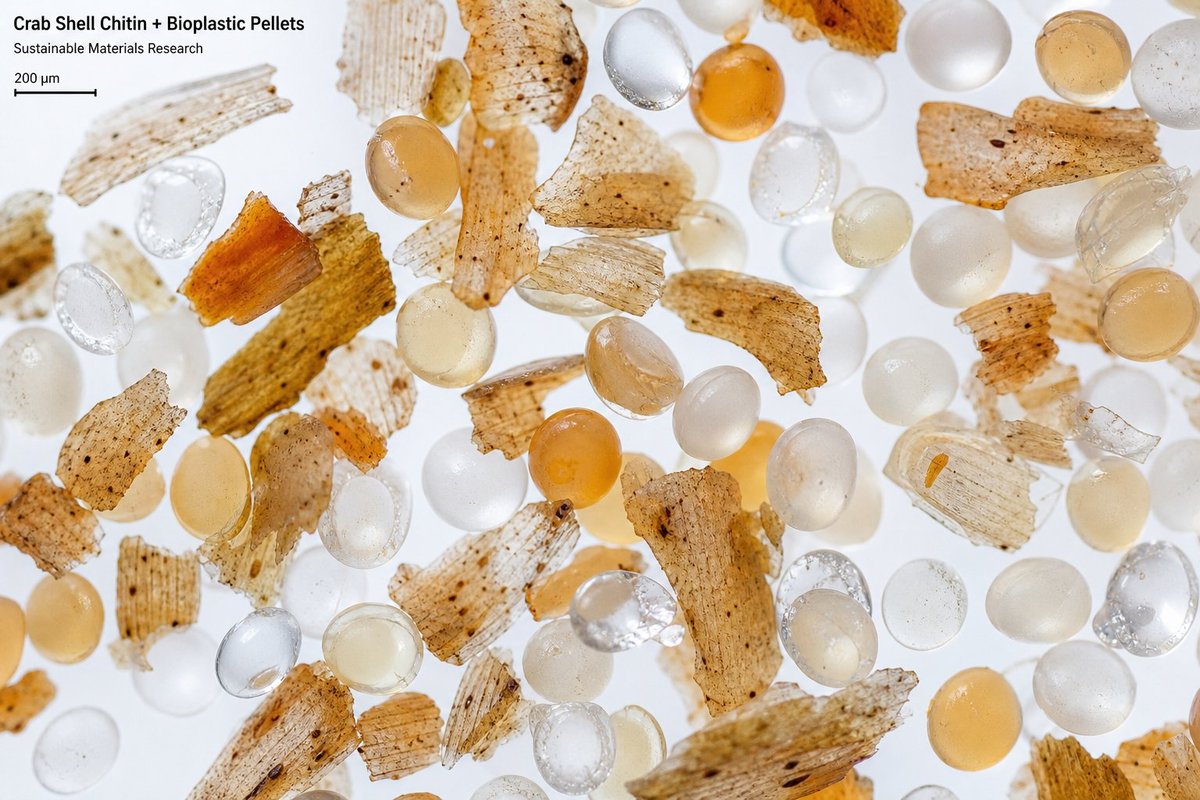
Unlocking Marine Biodegradability with Seafood Waste
While bioplastics offer a promising alternative to conventional petrochemical plastics, many bio-based polymers struggle to degrade efficiently in cold, nutrient-poor marine environments. Now, a joint research initiative by Gunma University and the Japan Agency for Marine-Earth Science and Technology (JAMSTEC) has unveiled a breakthrough: integrating pulverized crab shell waste into biopolymer matrices can actively control and accelerate degradation in seawater.
The Mechanism of Chitin-Driven Degradation
Crab shells are inherently rich in chitin, a naturally occurring structural polysaccharide. The research team discovered that blending chitin-dense waste into aliphatic polyesters acts as a powerful catalyst for microbial colonization.
In marine ecosystems, specific bacteria naturally produce chitinase—enzymes specifically designed to break down chitin. When bioplastics are compounded with crab shell particles, these chitin-degrading microorganisms rapidly colonize the material’s surface. As the bacteria congregate to feed on the chitin additive, they form robust biofilms. The heightened metabolic activity and localized enzymatic release not only consume the crab shell waste but actively accelerate the scission of the surrounding bioplastic polymer chains.
Tuning Material Lifespans for Industry
Beyond merely speeding up the breakdown process, the joint study highlights a crucial commercial benefit: tunability. By precisely adjusting the concentration of the crab shell additive during the compounding phase, manufacturers can engineer the exact lifespan of a bioplastic product. High-chitin blends can be utilized for short-term applications like agricultural films or single-use packaging, while lower concentrations can be formulated for durable goods that still require a fail-safe degradation mechanism if lost at sea.
A Circular Economy Breakthrough
This discovery represents a dual-victory for the circular economy. By upcycling abundant and often discarded seafood industry waste, the partnership between Gunma University and JAMSTEC has formulated a low-cost, bio-based additive that solves one of the bioplastic industry’s most persistent environmental hurdles.