Kemvera Advances Bio-Based Chemicals from Corn Ethanol, Aligning with USDA Priorities
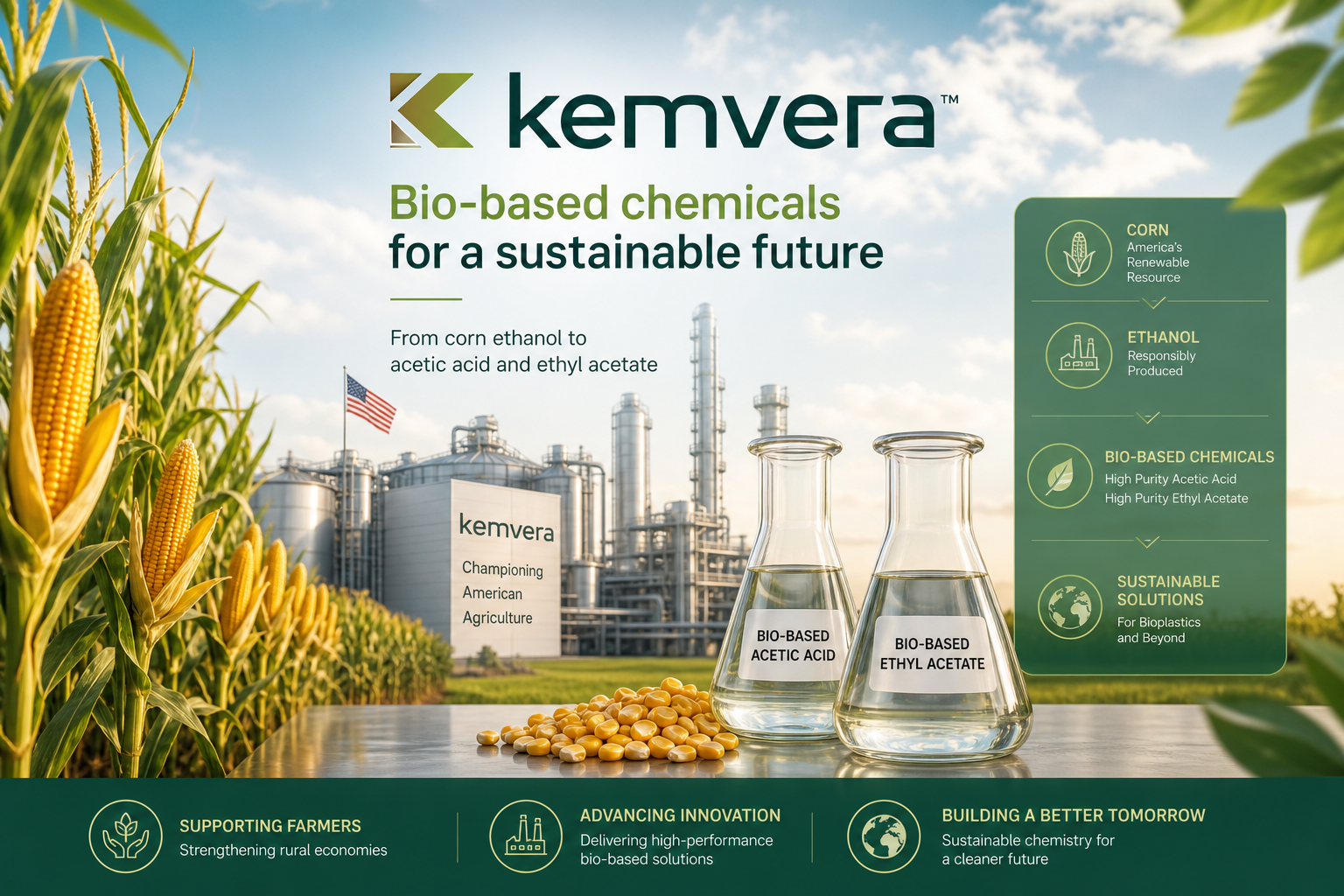
The manufacture of bioethanol-based chemicals is not just technologically timely — it is also politically and economically ripe. The U.S. Department of Agriculture’s 2026 research and development priorities emphasize supporting market growth and farmer profitability by creating new uses for American agricultural products, including expanding uses in new bio-based products. Converting abundant U.S. corn into higher-value, bio-based chemicals directly answers that call.
While European chemical giants are actively growing their biochemical footprint by expanding into Asia, the United States already has what others are trying to build: large-scale ethanol capacity, record exports, and an integrated agricultural system capable of supplying the next generation of bio-manufacturing. Instead of competing in shrinking fuel markets and exporting excess ethanol, the U.S. can capture more value by upgrading ethanol into chemicals and downstream materials.
This next chapter of the bioeconomy is about moving up the value chain by turning agricultural abundance into industrial leadership and positioning American farmers and manufacturers at the center of the rapidly growing global biochemicals market. Consumers are increasingly clamoring for bio-based products across many end-use markets.
So what is needed to connect supply with demand? Affordable, drop-in-ready bio-based chemicals at the scale the market requires. Kemvera is developing exactly that. The company has successfully commissioned its 20-ton pilot reactor and completed the process design package for its 50,000-ton-per-year commercial-scale plant. These milestones represent significant progress toward commercializing Kemvera’s manufacturing process that converts bioethanol into bio-based acetic acid and ethyl acetate.
The agricultural industry has taken note. Iowa — home to the most bioethanol plants in the nation — sees this as a critical opportunity. Joe Roberts, President of the Iowa Corn Promotion Board, explains that innovations like Kemvera’s help create new, high-value markets for corn, strengthen rural economies, and build on the success of corn ethanol by expanding domestic bio-manufacturing.
Unlike biofuels, which face limits imposed by the “blend wall” — the cap on how much biofuel can be mixed into the nation’s gasoline supply — bio-based chemicals have room to grow. The science is advanced, and the work ahead is straightforward: building on infrastructure that already exists and accelerating investment in domestic bio-based chemical manufacturing.
By pairing existing strength in bioethanol with downstream innovation, the United States can translate agricultural abundance into long-term industrial growth and farmer prosperity. Kemvera’s drop-in bio-based solutions support domestic manufacturing based on renewable agricultural feedstocks and enhance U.S. supply chain resiliency while enabling chemical manufacturers, distributors, and consumer brands to differentiate their products and strengthen competitiveness by decarbonizing and de-fossilizing supply chains.
Sources:
- Kemvera. “Cultivating Ag-Driven Markets: Transitioning Bioethanol to a Platform Feedstock Aligns with National Priorities.” March 11, 2026. https://www.kemvera.com/post/cultivating-ag-driven-markets
- USDA. “Secretary Rollins Announces New Priorities for Research and Development 2026.” December 30, 2025. https://www.usda.gov/about-usda/news/press-releases/2025/12/30/secretary-rollins-announces-new-priorities-research-and-development-2026