Olin and Huntsman Shareholders Approve $12.5 Billion Merger of Equals
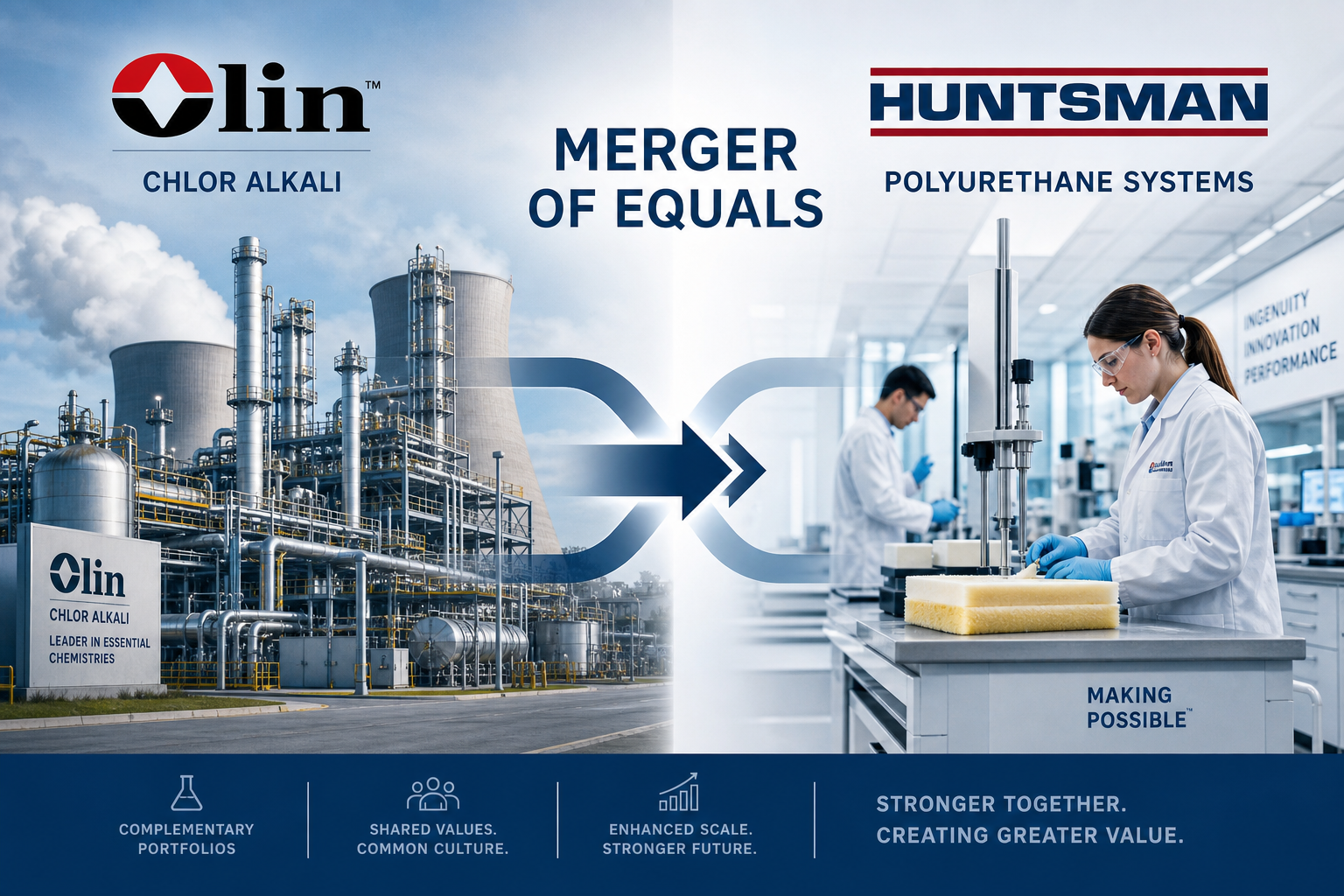
CLAYTON, Mo. & THE WOODLANDS, Texas — In a major step toward reshaping the North American industrial landscape, shareholders of Olin Corporation and Huntsman Corporation have overwhelmingly approved an all-stock merger of equals. The transaction, valued at approximately $12.5 billion, received approval from 97% of votes cast at Olin and 99% at Huntsman during special meetings held on August 25, 2026. The approval clears a critical threshold to establish OlinHuntsman Corporation, creating a highly integrated chemicals platform spanning 55 production sites across 25 countries.
The transaction brings together two major industry players with complementary portfolios. Olin contributed approximately $6.5 billion in revenue in 2025, while Huntsman brought $6.0 billion from its continuing operations. Under the terms of the agreement, the combined entity will operate as a true merger of equals with a fixed exchange ratio and no cash consideration. Pro forma net debt for the combined company stands at approximately $4.7 billion. Leadership will be shared across both legacies: Ken Lane, President and CEO of Olin, will serve as Chief Executive Officer of OlinHuntsman, while Peter Huntsman, Chairman, President, and CEO of Huntsman, will step into the role of non-executive Chairman of the Board.
Solving the Chlorine Balancing Problem
At the core of the merger is a strategic push to achieve deep vertical integration across the chlorine value chain, addressing a structural inefficiency that has challenged chemical manufacturers for decades.
As North America’s largest chlor-alkali producer, Olin generates chlorine and caustic soda as fixed co-products through an electrochemical process. Because market demand for chlorine rarely aligns perfectly with caustic soda, producers historically faced the difficult choice of selling excess chlorine into low-margin secondary markets or absorbing costs to destroy it.
Conversely, Huntsman has long been a major consumer of chlorine derivatives—such as methylene diphenyl diisocyanate (MDI) and propylene oxide—to feed its $3.5 billion polyurethane systems division. By purchasing these intermediates on the merchant market, Huntsman remained exposed to raw material price volatility.
The creation of OlinHuntsman directly links Olin’s upstream chlorine and caustic soda production with Huntsman’s midstream MDI and downstream polyurethane formulation networks. By internalizing the entire pipeline from basic brine extraction to high-margin specialty formulations, the combined entity captures full margin across the value chain, eliminates internal transfer pricing friction, and minimizes market exposure.
Synergy Potential and Financial Outlook
The merger is projected to unlock more than $400 million in total annual synergies, comprising over $300 million in direct cost savings and $100 million in commercial integration benefits. These estimates stem from granular asset-level planning rather than top-down assumptions.
Key drivers of these savings include:
- Internalized Feedstocks ($150 million): Streamlining the direct transfer of chlorine and caustic soda into MDI and propylene oxide production.
- Feedstock Optimization ($100 million): Capturing raw material cost savings across polyurethanes and epoxy networks.
- Procurement & Logistics ($100 million combined): Harnessing unified purchasing scale alongside optimized site and transportation networks.
- Administrative Overlap ($50 million): Consolidating general and administrative expenses.
Management expects to achieve approximately 50% of these synergy run-rates by the second year post-close, reaching 80% by year three. The resulting balance sheet is expected to maintain a pro forma net debt-to-EBITDA leverage ratio of approximately 2.0x, with cash flows directed toward rapid deleveraging below 2.0x within 24 months to preserve an investment-grade credit profile.
Broadened Portfolio and Market Reach
The combined business establishes a well-balanced portfolio capable of competing across every layer of the value chain.
Upstream, OlinHuntsman integrates brine, salt, ethylene, and chlor-alkali capabilities into an expansive Gulf Coast production complex. Midstream operations bring together vinyls, epoxies, MDI, TDI, and specialized amines. Downstream, the business stretches from industrial bleach to advanced polyurethane systems, CASE (coatings, adhesives, sealants, and elastomers) products, and structural composites. Olin’s Winchester ammunition division, which generates roughly $800 million in annual revenue, will continue to operate as a standalone business unit within the combined company.
This strategic alignment diversifies the company’s end-market exposure across automotive, construction, industrial manufacturing, water treatment, aerospace, and defense sectors. While Dow, BASF, and LyondellBasell maintain larger total revenue bases, OlinHuntsman positions itself as a streamlined competitor with deeper vertical polyurethane integration than regional peers such as Westlake or pure-play polyurethane producers like Covestro.
Sustainability and Next Steps
The merger also expands joint research and development capabilities, supported by a combined annual R&D budget exceeding $250 million. Key sustainability initiatives include pairing Olin’s epoxy resin backbone with Huntsman’s bio-based curatives for wind turbine blades, exploring bio-MDI pathways utilizing green hydrogen, scaling circular recycled polyols, and leveraging Gulf Coast carbon dioxide streams for polycarbonate production.
Despite strong shareholder backing, the merger faces standard integration risks, including regulatory scrutiny under vertical integration guidelines and the task of blending Olin’s central, engineer-focused corporate culture with Huntsman’s decentralized, entrepreneurial approach. However, both management teams expressed confidence in the transition.
“OlinHuntsman Corporation will be a more value-focused chemicals company with a world-scale vertically integrated platform that is better positioned to serve customers across the value chain and deliver resilient financial performance,” said Ken Lane, CEO of Olin.
Peter Huntsman added, “This merger of equals takes two great companies and creates a much stronger global leader, delivering greater value, expanded product portfolios, and enhanced service for our customers worldwide.”
With shareholder approvals secured, the companies are advancing regulatory filings under the Hart-Scott-Rodino Act and international competition laws. The transaction remains on track to close in the first half of 2027, subject to customary closing conditions. Both companies will maintain their existing dividend policies through the close of the transaction.