What Is PCR Plastic? Guide to Post-Consumer Recycled Content and GRS Certification
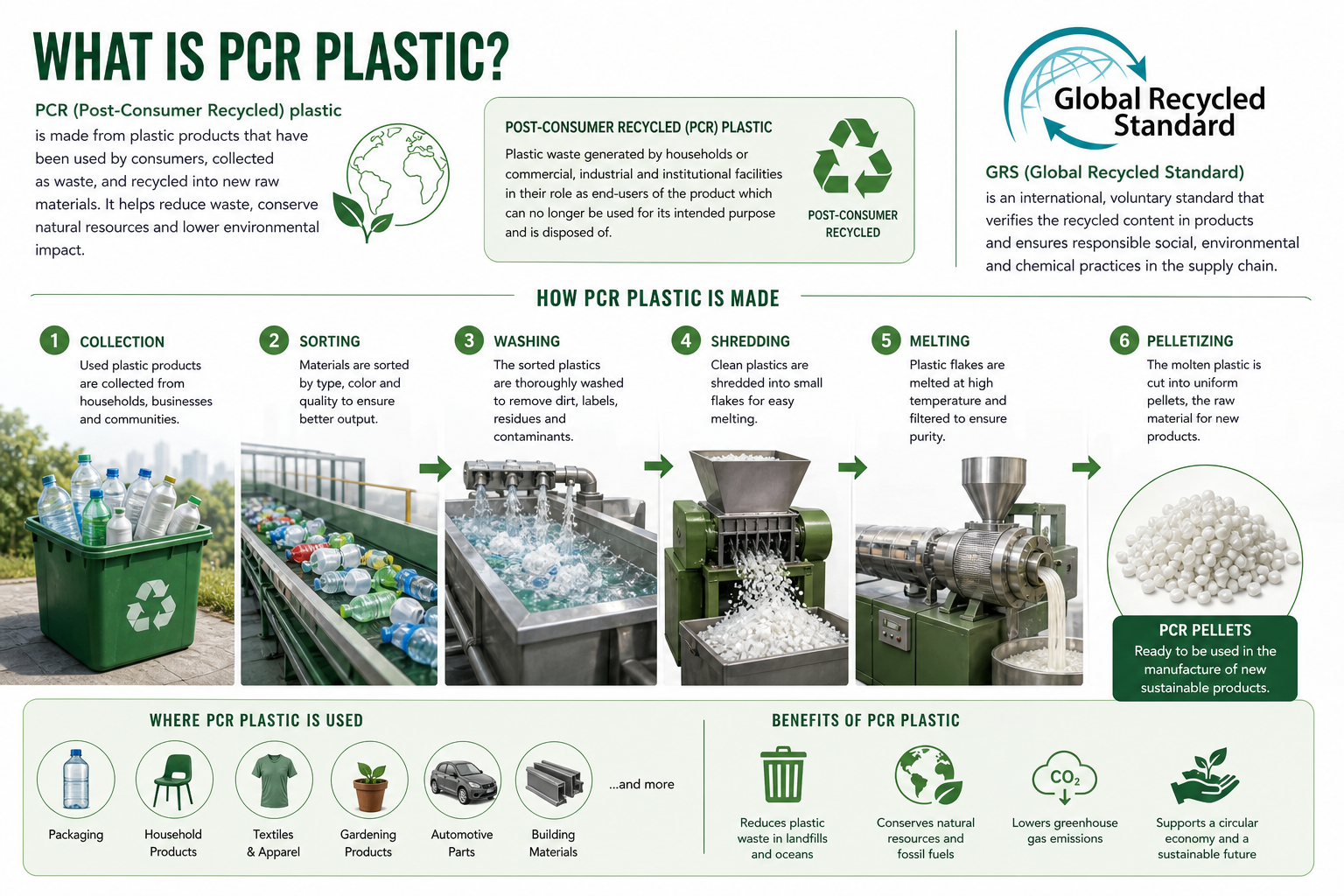
Post-consumer recycled (PCR) plastic has become a cornerstone of circular packaging strategies, yet confusion persists about what PCR actually means, how it differs from other recycled content claims, and which standards provide credible verification.
PCR plastic refers to plastic material made from waste generated by end consumers — households, commercial establishments, and institutional facilities — after its intended use. This distinguishes it from post-industrial recycled (PIR) content, which comes from manufacturing scrap and pre-consumer waste streams. PCR represents the most impactful form of recycling because it diverts material that has already completed its useful life as a consumer product, closing the loop on the linear “take-make-waste” model.
The PCR production chain involves several stages: collection from municipal recycling programs, sorting by polymer type (typically PET, HDPE, PP), washing to remove contaminants, shredding into flakes, washing and decontamination, extrusion and pelletizing into recycled resin. Each stage affects the quality and suitability of the resulting PCR for specific applications.
Quality and consistency are critical challenges. PCR can exhibit variability in color, molecular weight, contamination levels, and mechanical properties compared to virgin resin. Advanced sorting technologies (near-infrared sorting, density separation), multi-stage washing, and solid-state polycondensation (for PET) help bridge the performance gap. FDA and EFSA have established frameworks for food-contact PCR, requiring challenge tests to demonstrate that contaminants are reduced to safe levels.
The Global Recycled Standard (GRS), administered by Textile Exchange, has emerged as the leading international certification for recycled content verification. GRS applies to the full supply chain — from recycler to final product — and tracks the chain of custody through transaction certificates. It requires a minimum of 20% recycled content for product-level claims, with 50%+ for “Made with Recycled Materials” labeling. GRS also covers social, environmental, and chemical requirements throughout the supply chain.
For packaging specifically, the Recycled Content Certification from UL (ECVP 2809) and the Recycled Content Standard from SCS Global Services provide additional verification frameworks. In Europe, the EU’s Single-Use Plastics Directive and the upcoming Packaging and Packaging Waste Regulation (PPWR) set mandatory recycled content targets for PET bottles (25% by 2025, 30% by 2030) and other packaging formats.
Key questions for brands specifying PCR: What percentage of PCR is in the final product? Is it post-consumer or post-industrial? Which standard verifies the claim (GRS, RCS, UL, SCS)? Is there a chain-of-custody certificate for the specific batch? Does the PCR meet performance requirements for the intended application (mechanical properties, color, processability)?
The distinction between PCR and PIR matters for environmental impact claims. PCR diverts waste from landfill and incineration; PIR recycles manufacturing scrap that would likely be reprocessed anyway. Both have value, but PCR delivers the stronger circular economy narrative.
For consumers, third-party certification marks (GRS logo, Recycled Content certification) provide the primary assurance that “recycled” claims are credible. Brands should communicate the PCR percentage, the certification standard, and ideally the specific recycler to enable informed purchasing decisions.
As PPWR and other regulations take effect, PCR will transition from a sustainability differentiator to a regulatory requirement. Early adopters who build robust PCR supply chains and verification systems will be best positioned for compliance and consumer trust.
Sources:
- Bioelements, “Qué es el plástico PCR? Guía de contenido reciclado postconsumo y certificación GRS,” July 2026. https://www.bioelementsla.com/post/plastico-pcr-certificacion-grs
- Textile Exchange, “Global Recycled Standard (GRS).” https://textileexchange.org/standards/global-recycled-standard-grs/
- UL, “Environmental Claim Validation Program (ECVP) 2809.” https://www.ul.com/
- SCS Global Services, “Recycled Content Certification.” https://www.scsglobalservices.com/
- European Commission, “Packaging and Packaging Waste Regulation.” https://environment.ec.europa.eu/topics/waste-and-recycling/packaging-waste_en
Related Articles
What Is PCR Plastic? Guide to Post-Consumer Recycled Content and GRS Certification
Jul 29, 2026 · Bioelements provides an educational guide explaining post-consumer recycled …
Compostable Packaging: What It Is, How It Works, and What Certifications to Require
Jul 29, 2026 · Bioelements provides a comprehensive guide to compostable packaging, covering …
PEF: The Plant-Based Plastic That Could Replace PET
Jul 2, 2026 · PEF (polyethylene furanoate) is a 100% plant-based polymer with superior barrier …