PLA and PHA: From Rivals to Partners — The Real Convergence Story Unfolding in Bioplastics
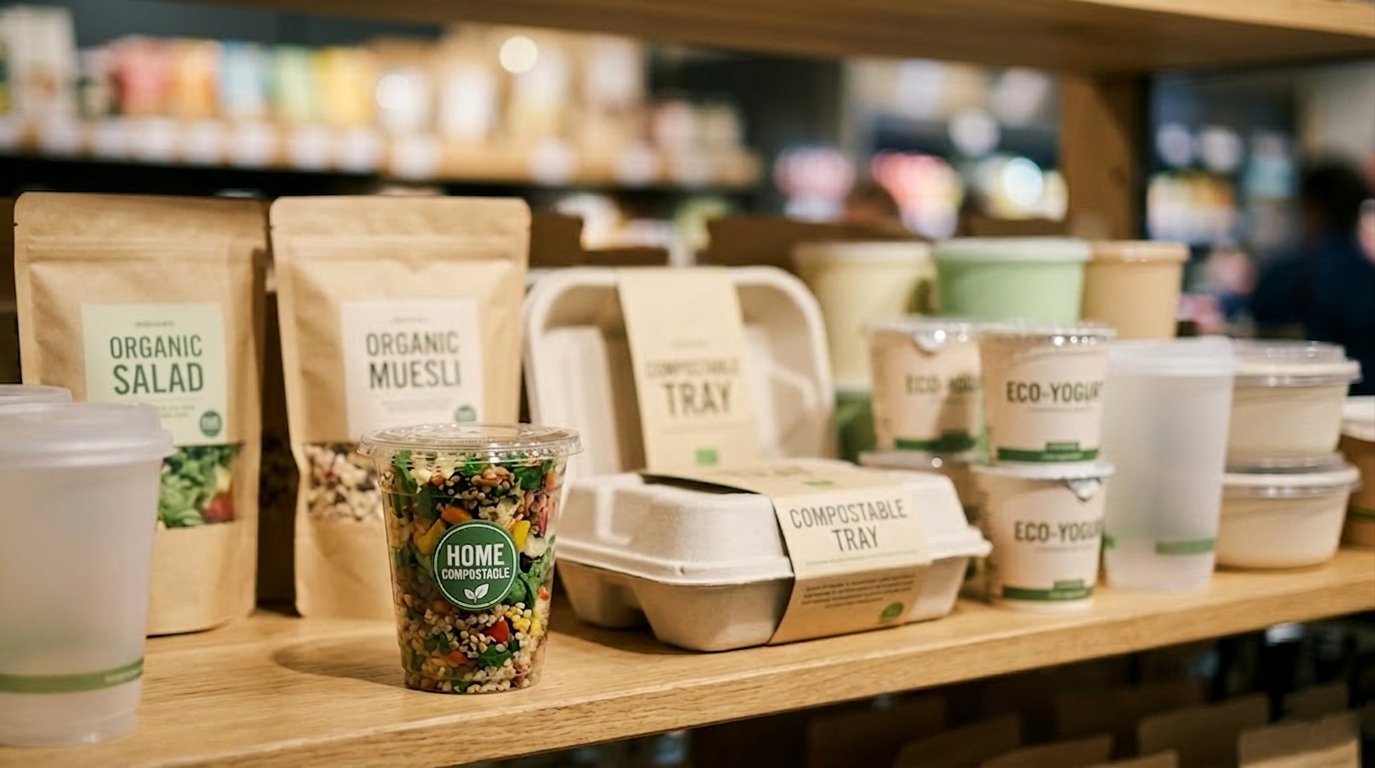
GORINCHEM, Netherlands / BAINBRIDGE, Georgia – A persistent narrative in bioplastics holds that PLA and PHA are locked in a zero-sum competition for the same packaging applications. The story is tidy: PLA is cheap and processable but limited to industrial composting; PHA is the premium, environmentally superior option but expensive and difficult to run. Pick your side.
The reality emerging from the market in 2025 and 2026 is considerably more interesting. The leading producers of both materials have stopped positioning them as alternatives and started positioning them as system components — complementary inputs that, when blended at the right ratios, resolve the critical weaknesses of each and unlock compostability certifications that neither can achieve independently. The driver is not corporate strategy alone. It is regulation: specifically, the EU’s Packaging and Packaging Waste Regulation (PPWR), which entered into force in February 2025 and begins full application in August 2026.
What each material actually does well — and where it fails
Understanding why blending makes sense requires being precise about the failure modes of each polymer when used in isolation.
PLA’s commercial strength is substantial. It is transparent, processable on standard converting equipment, and produced at scale by NatureWorks and TotalEnergies Corbion, among others. It carries EN 13432 industrial compostability certification, meaning it will fully disintegrate in a controlled composting facility operating above 58°C in roughly 12 weeks. For applications where industrial composting infrastructure exists and is accessible — certain corporate catering facilities, airport food courts, organized events — PLA is a credible end-of-life solution.
The problem is that most consumers do not have access to industrial composting. When PLA ends up in a home compost bin or general waste, it behaves essentially as a persistent plastic — degrading on a timescale of years rather than weeks, and potentially contaminating recycling streams if misidentified. Across much of Europe, the gap between PLA’s certified composting conditions and available end-of-life infrastructure is wide enough that the sustainability claim is difficult to defend in practice.
PHA has the inverse profile. Produced through bacterial fermentation of renewable feedstocks, PHA is the only certified plastic that biodegrades across all major environmental conditions: industrial composting, home composting, soil, and marine. In a world of perfect end-of-life pathways, PHA would be the obvious winner. The obstacles are commercial: PHA costs two to four times more than PLA per kilogram, fermentation-based production is energy-intensive and harder to scale, and the material is notoriously difficult to process — its narrow thermal processing window leads to degradation on extrusion and injection moulding lines optimised for conventional polymers. Pure PHA in flexible film applications is prone to brittleness after crystallisation and can be challenging to seal reliably.
The blend logic: what happens at the interface
The technical insight driving the PLA/PHA convergence is that amorphous PHA (aPHA) functions as a highly effective toughening modifier for PLA. Adding aPHA to PLA improves impact strength, tear resistance, and elongation at break — the mechanical properties most constraining for PLA in demanding flexible packaging. More importantly for compostability, it accelerates the disintegration of the PLA matrix under ambient conditions.
Research from CJ Biomaterials shows that bioplastics combining PLA and PHA degraded on average 98% in composting field tests, compared to approximately 83% for paper packaging. The critical threshold for home composting certification (TÜV Austria OK Compost Home) is reached when PHA is incorporated into PLA at levels exceeding approximately 30% by weight — at that point, the blend meets the certification’s requirement for disintegration at ambient temperatures between 20°C and 30°C within 180 days. This blend maintains high levels of certifiable biobased content and provides dramatic improvements in tear propagation resistance, puncture toughness, and tensile elongation relative to neat PLA.
In practical terms this means a packaging converter can run a material on existing PLA-configured equipment — with modifications — and produce a product certified for home composting, rather than the industrial composting that pure PLA requires. The compostability tier shifts from one that depends on municipal infrastructure to one that individual consumers can participate in.
The partnerships that are already operating
Contrary to the acquisitions and integrations that industry speculation sometimes projects, the actual commercial structure of the PLA/PHA convergence is built on supply agreements and market development partnerships — not vertical consolidation.
TotalEnergies Corbion and Danimer Scientific entered a long-term collaborative arrangement for the supply of Luminy® PLA to support growth in biopolymer production requiring blends of PHA and PLA inputs, enabling Danimer to fulfil customer needs for resins requiring both materials. This arrangement — announced in 2021 and expanded since — reflects TotalEnergies Corbion’s recognition that PLA-only solutions leave a portion of the composting performance envelope unreachable.
A parallel development is underway in Asia. TotalEnergies Corbion and Bluepha signed a memorandum of understanding in May 2023 to accelerate market adoption of PLA/PHA-based solutions in China, combining Bluepha® PHA with Luminy® PLA technology to advance high-performance biopolymer solutions. The collaboration has since moved from MOU to active product development, focusing on fiber applications where PHA’s antibacterial and soft-texture properties complement PLA’s processability. A real-world application has already emerged: TotalEnergies Corbion’s Luminy High Heat PLA and Danimer Scientific’s Nodax PHA have been incorporated into a TÜV-certified compostable coffee pod designed to adhere to upcoming EU legislation on biodegradability.
None of these arrangements represent a strategic pivot away from either company’s core identity. TotalEnergies Corbion remains a PLA producer. Danimer Scientific and Bluepha remain PHA companies. What is changing is the commercial framing: blended system solutions are being developed, certified, and brought to market through co-development rather than through vertical integration.
The PPWR pressure point: why 2026 matters
The regulatory context shaping all of this is the PPWR, which entered into force in February 2025. The regulation entered into force on 11 February 2025 and applies from 12 August 2026. Compostable packaging must meet industrial composting standards, and member states may require compostability for specific packaging types if appropriate infrastructure exists.
Two features of the PPWR are particularly consequential for PLA/PHA blends. First, the PPWR exempts compostable plastic packaging from the recycled content requirements that apply to conventional plastics — a logical exemption since biodegradable polymers used to produce compostable packaging are lost in the composting process and cannot be recovered to create new packaging. This means that a compostable PLA/PHA blend is not competing on recycled content metrics against rPET or rPP; it plays by different rules.
Second, the regulation gives member states discretion to mandate home composting rather than industrial composting for specific packaging categories where the infrastructure justifies it. France, Belgium, and the Netherlands have already moved toward home composting standards for certain food service items. For brand owners selling into multiple European markets, this creates a bifurcated compliance challenge: some markets require industrial compostability (satisfied by pure PLA), others are moving toward home compostability (requiring PHA content at sufficient levels). A single PLA/PHA formulation tuned to the home composting threshold satisfies both tiers simultaneously — a compelling value proposition for a packaging converter managing a pan-European customer.
The cost problem has not gone away
The convergence narrative deserves one significant counterweight: cost. The global PHA market was valued at approximately USD 138 million in 2025 — a fraction of the PLA market, and a reflection of the production economics that still make PHA a premium input. Adding 30% PHA to a PLA formulation meaningfully increases the resin cost of the blend, and in packaging markets where material economics are fought in fractions of a euro cent per gram, that delta matters.
The economics are improving but not yet resolved. Several PHA producers — CJ Biomaterials, Kaneka, Newlight Technologies — are advancing fermentation efficiency and scale, and waste feedstock projects using methanol, carbon dioxide, and food industry residues are beginning to offer lower-cost PHA production routes. But as of 2026, PHA/PLA blends occupy a premium segment within compostable packaging, not a mass-market position.
The regulatory and brand-owner dynamics are moving in the direction that justifies that premium, however. As PPWR enforcement begins in August 2026 and as home composting certification becomes a genuine differentiator in competitive packaging tenders, the willingness to pay for a blend that delivers certified home compostability — rather than the industrial-only equivalent — is increasing measurably.
What to watch
Three developments will determine how quickly this convergence matures. The first is PHA capacity: without meaningful new fermentation capacity coming online in Europe and North America, supply constraints will cap blend adoption regardless of regulatory demand. The second is certification standardisation: the patchwork of home composting standards across EU member states creates certification complexity that slows specification decisions at the converter level. The third is infrastructure: compostable packaging only delivers its environmental promise if end-of-life collection and composting systems actually receive and process it — a condition that remains unmet across most of Europe outside of dedicated pilot schemes.
The rivalry framing that defined PLA and PHA’s relationship for the past decade has largely served neither material well. The more productive question — which is now being asked in product development labs and procurement offices — is what ratio of which material solves which specific end-of-life challenge for which specific market. The answer, increasingly, involves both.
Sources: TotalEnergies Corbion Newsroom · CJ Biomaterials / Food Navigator · EUR-Lex – PPWR Regulation EU 2025/40