A Regulatory Own Goal: The USDA's Rejection of Compostable Bioplastics
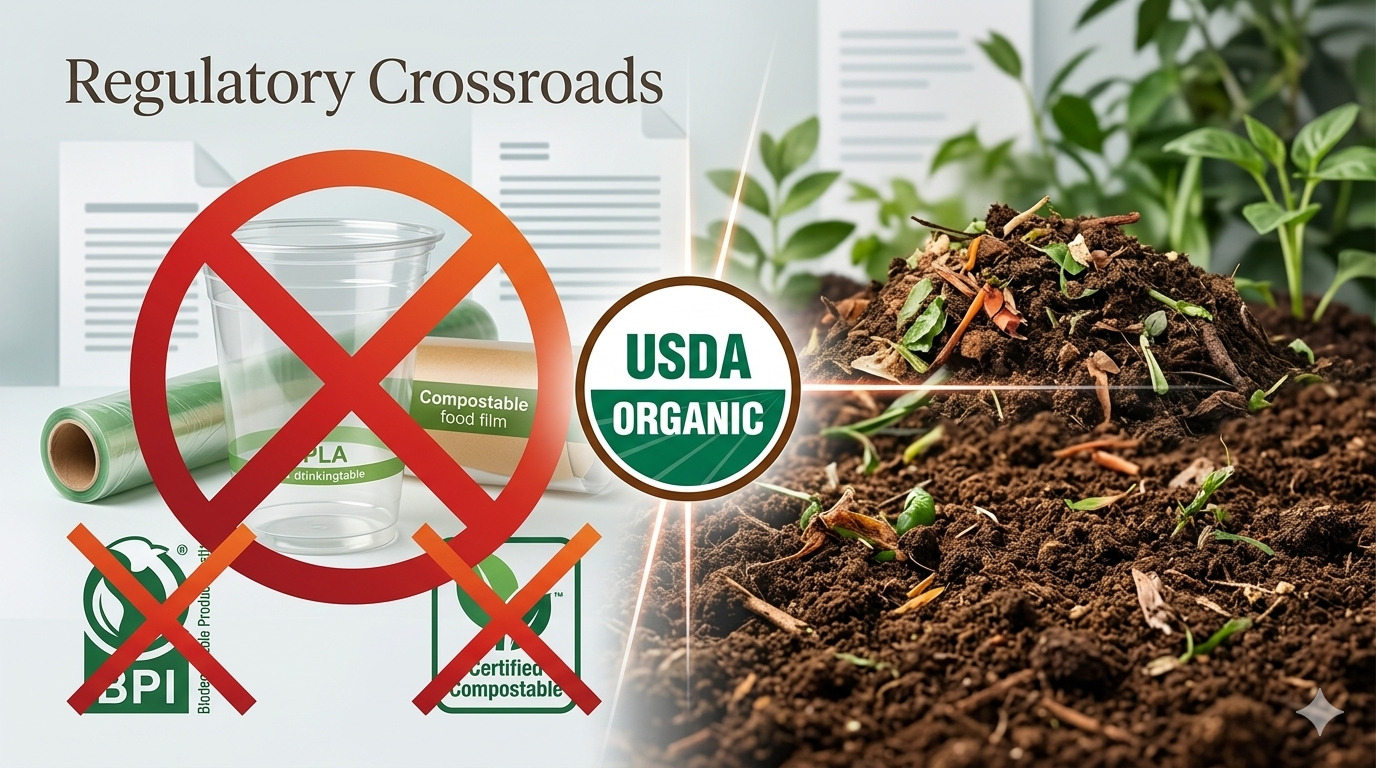
In January 2026, the U.S. Department of Agriculture’s National Organic Standards Board (NOSB) voted unanimously to reject synthetic compostable materials as allowable feedstocks for certified organic compost. The decision caps a multi-year review process and represents a significant setback — not just for the bioplastics industry, but for the broader ambition of building circular, low-waste food systems.
The ruling deserves scrutiny. Because while the NOSB’s concerns are not without basis, the board’s central argument rests on a regulatory technicality that, when examined through the lens of actual chemistry and environmental outcomes, starts to look less like science and more like definitional gatekeeping.
The Background: What Was Actually Being Asked
The vote was triggered by a 2023 petition from the Biodegradable Products Institute (BPI), a nonprofit representing manufacturers of certified compostable packaging. BPI asked the USDA to revise the definition of “compost feedstock” to include materials meeting ASTM International compostability standards — the widely recognized certification for PLA (Polylactic Acid), PBAT, PHA (Polyhydroxyalkanoates), and similar polymers.
The stakes were high, particularly in California. Under state law SB 343, any packaging labeled “compostable” must qualify as an allowable input under the NOP. Without a positive ruling, compostable packaging faces effective market exclusion in the state — the largest compost market in the country, where commercial composters sell roughly 75% of their output to agriculture.
After extensive public commentary, a commissioned technical review, and BPI’s rebuttal, the NOSB voted against inclusion across broad material classes. The board did leave the door open for reviewing individual substances in restricted applications, such as fruit stickers and food-scrap collection bags. But for the industry at large, the ruling stings.
The USDA’s Concerns — And How Well Do They Hold Up?
1. The “Synthetic Origin” Argument — A Definitional Dead End
The NOSB’s foundational objection is not a scientific one — it’s definitional. Under the organic regulations, compost feedstocks must consist of natural plant and animal materials. Compostable polymers like PLA, derived from corn starch or sugarcane, are polymerized through industrial processes and therefore classified as synthetic. The board concluded: “substances that start as synthetic end as synthetic, even if the chemical change was the result of a biological process.”
This sounds principled. But it falls apart under chemical scrutiny.
The entire purpose of industrial composting is biological conversion: microorganisms break down complex organic molecules — whether from a banana peel, a cotton shirt, or a PLA cup — into water, CO₂, and stabilized biomass (humus). At the end of a certified composting cycle, a PLA polymer no longer exists. What remains is indistinguishable from the breakdown products of any other plant-derived material, because it is the breakdown product of a plant-derived material. PLA is made from lactic acid — a molecule produced naturally in every living organism — polymerized and then depolymerized back to its elemental constituents by microbial activity.
Compare this to the actual synthetics organic farming does tolerate: polyethylene (PE) mulch films are currently permitted under NOP, despite the fact that PE does not biodegrade and leaves persistent plastic fragments in soil for centuries. If the concern were truly about protecting soil from synthetic residues, PE mulch would be the priority target — not PLA that composting converts entirely back into CO₂ and water.
The NOSB’s logic also creates a curious paradox. Wine vinegar — produced from grape juice through chemical oxidation — would presumably be “synthetic” under this framework, as would many fermentation-derived compounds that pass through engineered biological processes. The board’s position conflates the origin of a manufacturing process with the nature of the final environmental output. These are not the same thing.
Verdict: Debatable at best. The “once synthetic, always synthetic” doctrine is a regulatory artifact, not a scientific finding. An outcomes-based standard — one that asks what actually ends up in the soil after composting — would reach a very different conclusion for certified compostable biopolymers.
2. PFAS and Additive Contamination — A Real Issue, Wrongly Generalized
The concern about PFAS (per- and polyfluoroalkyl substances) entering organic soils through compostable packaging is genuine and should be taken seriously. PFAS have been used in some grease-resistant food-contact coatings, and their persistence in soil and water is well-documented. Some compost streams accepting mixed compostable foodservice items have shown elevated PFAS levels.
But here the NOSB makes a category error. PFAS contamination is a problem with certain applications of compostable packaging — particularly fiber-based items with fluorochemical coatings — not with compostable biopolymers as a class. PHA and PLA packaging produced without PFAS coatings carries none of this contamination risk. The bioplastics industry has been actively moving away from PFAS-containing materials, and certified compostable products from leading producers like NatureWorks or CJ Biomaterials do not require fluorochemical treatments.
Blaming bioplastic polymers for PFAS contamination is a bit like banning organic cotton because some cotton is treated with pesticides. The correct response is stricter substance-level standards and transparent ingredient disclosure — which the industry has consistently advocated for — not a blanket ban on all compostable materials.
Verdict: The concern is real but misapplied. PFAS contamination requires targeted regulation, not categorical exclusion of all compostable polymers. The NOSB’s own openness to reviewing individual substances is an implicit acknowledgment of this.
3. Operational Infeasibility — An Infrastructure Problem, Not a Material Problem
Composting operators raised a practical objection: they cannot reliably sort certified compostable packaging from look-alike conventional plastics at industrial scale. This is fair, and contamination from non-compostable plastics entering the stream is a genuine operational headache.
But here the causal logic is inverted. The sorting challenge exists because compostable packaging has been excluded from the organic compost stream — creating a situation where composters, to protect their certification, must treat all plastic-appearing items as suspect. If compostable packaging were a recognized, labeled, and accepted feedstock, the incentive and investment in sorting technology would follow.
The bioplastics industry has been pushing for clearer standardized labeling — including industrial-grade color coding and scannable certification marks — precisely to address this. The NOSB decision removes the commercial incentive for composters to invest in that infrastructure, making the problem it cites worse, not better.
Verdict: Partially valid, but self-reinforcing. Operational challenges are real but solvable, and this ruling makes them less likely to be solved.
4. No Clear Benefit to Organic Agriculture — A Narrow Frame
The NOSB found that compostable materials failed the National List criteria on necessity: the argument being that organic farming doesn’t need compostable packaging in its compost stream. This is true in the narrow sense that organic farmers have been composting without it for decades.
But the frame is too narrow. The benefit of integrating compostable packaging into the organic compost stream is systemic — it improves food waste capture rates, reduces contamination in collection programs, and enables municipalities to achieve the kind of high-diversion composting systems that reduce methane emissions from landfills. A USDA that is serious about sustainable agriculture and climate goals should be asking whether the existing regulatory definition of compost is fit for a world in which biobased packaging is now a real and growing part of the waste stream.
The organic farming community’s concerns about protecting soil integrity are understandable and legitimate. But “no clear benefit” ignores the significant environmental cost of sending compostable packaging to landfill — the direct consequence of this ruling.
Verdict: Too narrow. The systemic environmental case for integration was not adequately weighed against the risk of marginal disruption to existing organic compost programs.
What This Means for the Industry
The practical fallout is significant.
California faces a market crisis. Without positive federal rulemaking, compostable packaging risks effective exclusion from the California market after CalRecycle’s extended deadline of June 30, 2027. That would gut the commercial viability of compostable formats for the U.S. food service industry.
Composters will tighten acceptance. Major commercial composters, protecting their organic certification premium, will increasingly reject compostable packaging — forcing it into landfill and undermining the entire environmental rationale for these materials.
The industry is fighting back on two fronts. BPI is pursuing USDA rulemaking to update the definition of “compost” itself (rather than adding materials to the National List one by one), and supporting California legislation to decouple compostable labeling requirements from NOP standards. Dozens of major players — including NatureWorks, Georgia-Pacific, Atlantic Packaging, and the Consumer Brands Association — have signed on to BPI’s push for federal rulemaking. The argument that this supports domestic manufacturing and reduces foreign feedstock dependence may find a sympathetic ear in the current political climate.
PHAs and specific applications still have a path. The NOSB’s case-by-case openness is a genuine opportunity. PHA biopolymers — fully biosynthesized by microorganisms, containing no petrochemical inputs, and leaving no known persistent residues — present the strongest case for near-term inclusion. The industry should prioritize building that evidentiary record.
The Bigger Picture
The USDA ruling reflects a regulatory framework that was designed for a different era. The National Organic Program’s feedstock rules were written before the existence of biopolymers derived from renewable resources and certified to break down completely under industrial composting conditions. Applying those rules unchanged to a new generation of materials leads to outcomes that satisfy regulatory logic but fail environmental common sense.
The organic farming community’s instinct to protect soil integrity is admirable and worth defending vigorously. But the most effective way to do that is through rigorous, substance-specific standards and transparent supply chains — not through definitional exclusion of an entire material category whose end-state in the soil is, by design and certification, nothing at all.
Compostable bioplastics were created to solve a real and urgent problem. The answer to an imperfect solution is not to push it back into the landfill. It is to make it better.
Sources: USDA NOSB Final Recommendation on Compost (January 2026); BioCycle; Packaging Dive; National Organic Coalition; Civil Eats; BPI petition materials